The idea: two ways to find the same components
A strongly connected component (SCC) of a directed graph is a largest set of vertices that can all reach each other. Both algorithms on this page find every SCC in O(V + E) time, and both are built on depth-first search. They differ in how much work they repeat and what they keep in memory. The page runs them on the same graph, one unit of work per Step in each lane, so the lane with less work finishes first.
Kosaraju: two passes and a reversed graph
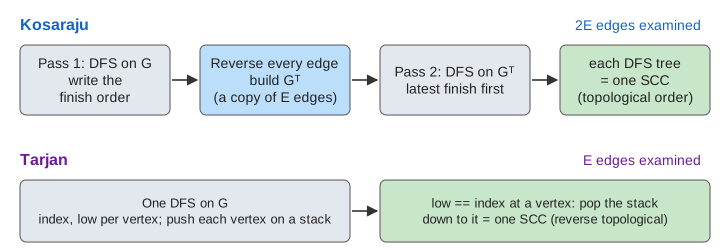
Pass 1 runs a full DFS on G and writes each vertex onto a finish list when its call returns. The last vertex to finish always lies in a "source" SCC, one that no other SCC points into. Then the algorithm builds the transpose GT, the same graph with every edge reversed; it has exactly the same SCCs. Pass 2 takes vertices from the end of the finish list and starts a DFS on GT from each one that has no component yet. In GT the edges that left the source SCC now point into it, so the DFS cannot escape: every tree it grows is exactly one SCC. The single-concept page is Connected Components (Kosaraju).
Tarjan: one pass with low-links
Tarjan's DFS gives each vertex an index (the order it is reached) and a low value: the smallest index it can reach through its DFS subtree plus one more edge to a vertex that is still on the stack. Every visited vertex is pushed on that stack. When a vertex finishes with low == index, nothing below it reaches higher up, so it is the root of an SCC and the stack is popped down to it. The canvas shows index/low next to each vertex. The single-concept page is Strongly Connected Components (Tarjan).
What the scoreboard counts
| Demo | SCCs | Edges examined (K / T) | Steps (K / T) | Extra memory, words (K / T) |
|---|---|---|---|---|
| 8-node graph | {A,B,E} {C,D} {F,G} {H} | 26 / 13 | 59 / 36 | 29 / 30 |
| A DAG | 8 single vertices | 22 / 11 | 55 / 34 | 27 / 29 |
| One big cycle | {A..H} | 20 / 10 | 53 / 33 | 26 / 32 |
| Forgets to reverse | Kosaraju: 1 ✗, Tarjan: 4 ✓ | 26 / 13 | 59 / 36 | 29 / 30 |
Edges examined is always 2E for Kosaraju (every edge once per pass) and E for Tarjan. Extra memory is a rough count of words beyond the graph itself: Kosaraju stores the reversed copy (E edges), the finish list and a visited flag (E + 2V); Tarjan stores index, low and on-stack per vertex plus the stack at its tallest (3V + stack). On these sparse graphs Kosaraju's copy is small, so it wins memory, most clearly on the big cycle, where Tarjan's stack holds all 8 vertices (Demo: one big cycle, one SCC). On a dense graph, where E is many times V, the copy dominates and Tarjan uses far less.
Order of the output
Shrink every SCC to one node and you get the condensation, which is always a DAG. Kosaraju emits the SCCs in topological order of that DAG (sources first); Tarjan emits them in reverse topological order (sinks first), because an SCC is popped only after every SCC it points to is done. On a DAG every SCC is one vertex, so this is visible directly: Kosaraju lists A E B F C G D H, a topological order, and Tarjan the reverse (Demo: a DAG, every SCC is one vertex). See Topological Sort (DFS), which uses the same finish-order trick as Kosaraju's pass 1.
When to pick which
| Kosaraju | Tarjan | |
|---|---|---|
| Passes over the edges | 2 (plus building the reversed graph) | 1 |
| State per vertex | visited flag, finish list | index, low, on-stack, stack |
| Extra memory | a copy of all E edges (unless in-edges are stored anyway) | O(V) |
| Output order | topological | reverse topological (what 2-SAT wants) |
| Easy to get right | yes: two textbook DFS passes | the low-link rule is subtle |
| Pick it when | the graph already stores in-edges, or clarity matters most | speed and memory matter, or the graph is huge or streamed once |
Common mistakes
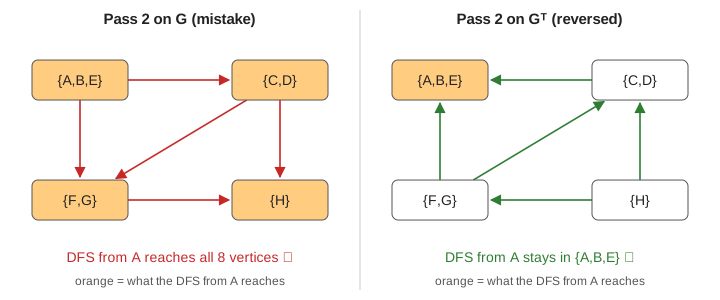
- Forgetting to reverse the graph. Pass 2 on G starts in the source SCC and walks out of it into everything downstream; on the 8-node graph it returns all 8 vertices as one "component" (Demo: Kosaraju forgets to reverse).
- Using the wrong order in pass 2. It must be decreasing finish time (the end of the finish list), not discovery order or A, B, C.
- In Tarjan, updating low from a vertex that is not on the stack. An edge into a finished SCC must be ignored, or two SCCs merge.
What the page leaves out
Both algorithms are shown recursively, on one small graph at a time, with neighbours tried in alphabetical order. The page leaves out iterative versions (deep recursion overflows the call stack on large graphs), Pearce's variant of Tarjan that saves the on-stack bit, the path-based algorithms of Gabow and Cheriyan–Mehlhorn, parallel and external-memory SCC algorithms, and the real cost of memory access, which on big graphs often matters more than edge counts.