The idea: one angle, many seeds
In 1979 Helmut Vogel described the seed head of a sunflower with two short rules. Number the seeds n = 1, 2, 3, … from the centre out. Then
angle   θₙ = n · α        (α is a fixed fraction of a turn)
radius  rₙ = c · √n       (c sets the seed size)
Each seed is turned by the same angle α from the one before it and sits a little farther out. That one number α decides the whole picture: straight spokes, curved arms, or the even packing of a real sunflower. The arrangement of leaves and seeds around a stem is called phyllotaxis.
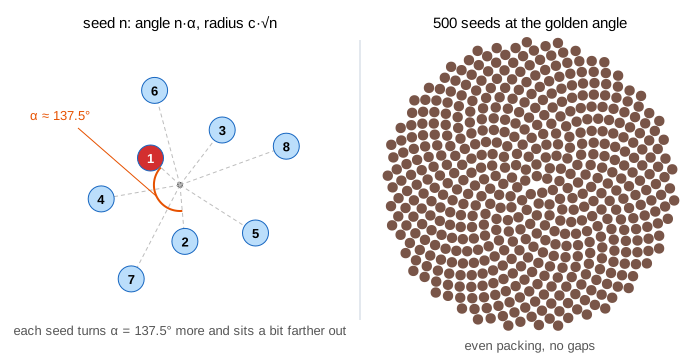
A real flower head grows the other way round: new seeds form in the middle and push the older ones outward. The page grows it like that (Demo: grow 500 seeds at the golden angle): the newest seed is always n = 1, so the rules above still hold at every moment.
Why the radius is c·√n
The first n seeds fill a disk of radius c·√n, whose area is π·c²·n. So every new seed adds the same area π·c²: the density is the same everywhere, near the centre and at the rim. With r = c·n the seeds would spread thinner and thinner outward; with r = c·n² even more so. The page sets c = R/√N so that N seeds always fill a head of radius R.
A fraction makes spokes
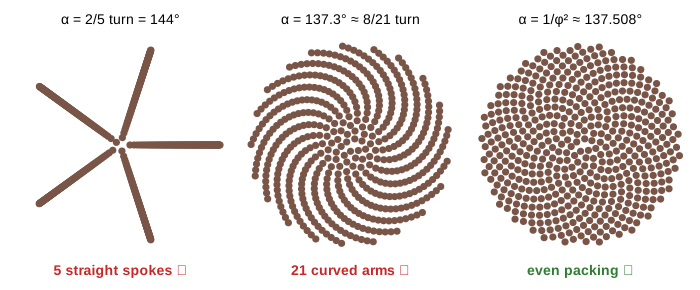
Say α = p/q turn, a fraction in lowest terms. After q seeds the turns add up to exactly p whole turns, so seed n + q lands on the same ray as seed n. The seeds fall on q straight spokes with empty wedges between them: a waste of space.
| α | in degrees | what you see |
|---|---|---|
| 1/2 turn | 180° | 2 spokes, a straight line |
| 1/3 turn | 120° | 3 spokes |
| 2/5 turn | 144° | 5 spokes |
| 3/8 turn | 135° | 8 spokes |
| 5/13 turn | 138.46° | 13 spokes |
| 0.1 turn | 36° | 10 spokes |
An angle that is only close to p/q does almost the same: every q-th seed lands almost on the same ray, the small error adds up, and the spokes bend into q curved arms. 137.3° is close to 8/21 turn and shows 21 arms; 137.6° is close to 13/34 and shows 34. π − 3 turn (50.97°) is close to 1/7, which gives 7 arms that curl about 1¼ turns. (Demo: α = 2/5 turn gives 5 straight spokes, Demo: 137.3° vs the golden angle vs 137.6°.)
The most irrational number
So the best α is the one that is far from every fraction. Every number has a continued fraction α = 1/(a₁ + 1/(a₂ + 1/(a₃ + …))), written [0; a₁, a₂, a₃, …]. You get it the way Euclid's algorithm divides: take the whole part, flip the rest, repeat. Cutting it off early gives the convergents, the best fractions with a small denominator. A big term aₖ means the convergent just before it is unusually good: π − 3 = [0; 7, 15, 1, 292, …], and the 15 after 1/7 is why 7 arms show.
The golden ratio φ = (1 + √5)/2 ≈ 1.618 has the smallest terms possible: φ = [1; 1, 1, 1, …]. That makes it the "most irrational" number: its convergents approach it as slowly as any number's can. The golden angle is 1/φ² of a turn:
α = 1/φ² = 2 − φ ≈ 0.381966 turn = 360°/φ² ≈ 137.508°      1/φ² = [0; 2, 1, 1, 1, 1, …]
convergents: 1/2, 1/3, 2/5, 3/8, 5/13, 8/21, 13/34, 21/55, 34/89, …
Both the tops and the bottoms are Fibonacci numbers 1, 1, 2, 3, 5, 8, 13, 21, 34, 55, … (each the sum of the two before, see Dynamic Programming (Fibonacci)). No fraction is ever much closer than these, so no spokes ever form. √2 − 1 = [0; 2, 2, 2, …] is also badly approximated, with Pell numbers 2, 5, 12, 29, 70 as its denominators, and looks almost as even (Demo: √2 − 1 and π − 3, irrational but not golden).
Where the Fibonacci spirals come from
At the golden angle the eye still sees spirals, called parastichies. Seeds n and n + 21 are close to each other because 21·α is only 7.7° past 8 whole turns, and seed n + 21 is just a little farther out. So the seeds n, n + 21, n + 42, … form one gentle spiral, and there are 21 of them, one for each value of n mod 21. The same holds for 34 (34·α is 4.7° short of 13 turns, so these spirals turn the other way). Colour the seeds by n mod 21 or n mod 34 to see them: one class is drawn in red, the others alternate blue and amber (Demo: Fibonacci spirals, n mod 21, 34, 55, with 500 seeds).
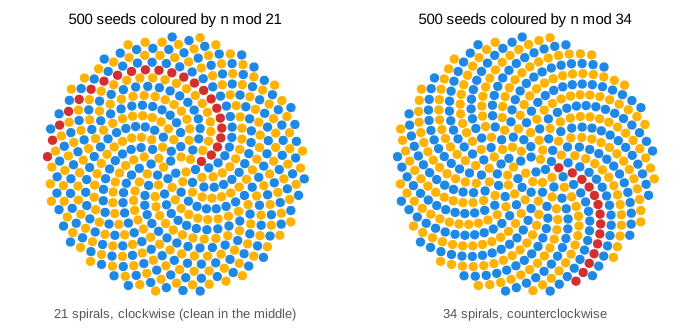
Which pair you see depends on how far out you look. A seed's nearest neighbours are n ± q for two consecutive Fibonacci numbers q, and the pair moves up the Fibonacci list as the radius grows: the "nearest seeds" row on the canvas shows it for a seed 3/10 and 4/5 of the way out.
| seeds N | nearest seeds in the middle | nearest seeds at the rim |
|---|---|---|
| 100 | n ± 13, 21 | n ± 13, 21 |
| 500 | n ± 21, 34 | n ± 34, 55 |
| 1000 | n ± 34, 55 | n ± 55, 89 |
| 2000 | n ± 55, 89 | n ± 89, 144 |
So with 500 seeds the n mod 21 colours make clean spirals in the middle and break up toward the rim, while n mod 34 and n mod 55 are clean at the rim. Real sunflowers, with more seeds, show 34 and 55 or 55 and 89 spirals at the rim for the same reason.
Watching α sweep
Play α sweep moves α slowly with the head full. From 137° to 138° in steps of 0.005° (Demo: sweep α from 137° to 138°), the head goes from 21 curved arms (137°, close to 8/21) through the even golden angle in the middle to 34 arms (137.6°, close to 13/34) and 13 arms (138°, close to 5/13). From 0 to ½ turn in steps of 0.25° (Demo: sweep α from 0 to ½ turn) every simple fraction flashes by as spokes, with curved arms in between. The speed choice sets how many animation frames each step gets. Another picture where one number and its fractions decide the pattern is The Times-Table Circle; for the polar coordinates θ and r themselves, see Polar Coordinates, and for a curve that closes only when its parameter is a fraction, The Rose Curve r = cos kθ. Integers placed on a square spiral show patterns too: The Ulam Spiral.
What the page leaves out
Why plants pick the golden angle: models of the growing tip (Hofmeister's rule, Douady and Couder's magnetic-drop experiment) show that each new seed forming in the biggest gap leads to it, but the page only takes α as given. Also left out: seeds of different sizes, the exact proof that φ is the worst approximable number (Hurwitz's theorem, |α − p/q| > 1/(√5·q²) fails only for φ-like numbers), leaf arrangements on stems (2/5 and 3/8 do occur there), and the formula for which parastichy pair shows at a given radius.