The idea: two laws, two unknowns
Two balls roll toward each other on a straight, frictionless track. We know their masses m₁, m₂ and their velocities v₁, v₂ before the hit (+ means to the right). We want the two velocities after the hit, v₁' and v₂'. Two unknowns need two equations, and physics gives us two:
- Momentum p = m·v is always the same before and after: m₁v₁ + m₂v₂ = m₁v₁' + m₂v₂'.
- In an elastic collision the kinetic energy ½mv² is the same too: ½m₁v₁² + ½m₂v₂² = ½m₁v₁'² + ½m₂v₂'².
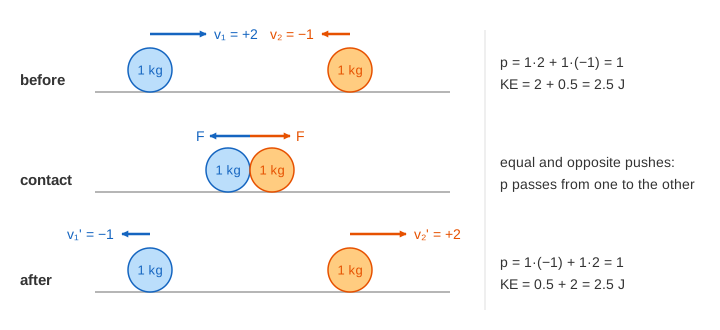
Momentum is always kept
During the short contact ball 1 pushes ball 2 with a force F, and ball 2 pushes back with −F (Newton's third law). They push for the same time, so ball 2 gains exactly the momentum ball 1 loses. No outside force acts along the track, so the total p = m₁v₁ + m₂v₂ cannot change. This holds for every collision, bouncy or sticky. On the page the momentum bars show it: the two parts are laid end to end, and the end of the "after" row lands on the same purple line as the "before" row.
Solving for v₁' and v₂'
Move the ball-1 terms to one side in both equations:
m₁(v₁ − v₁') = m₂(v₂' − v₂)                 momentum
m₁(v₁ − v₁')(v₁ + v₁') = m₂(v₂' − v₂)(v₂' + v₂)    energy, using a² − b² = (a − b)(a + b)
Divide the second line by the first and almost everything cancels: v₁ + v₁' = v₂ + v₂', or v₂' − v₁' = −(v₂ − v₁). The relative velocity flips: the speed at which the balls close in is the speed at which they fly apart. Put that back into the momentum equation and you get
v₁' = (m₁ − m₂)/(m₁ + m₂)·v₁ + 2m₂/(m₁ + m₂)·v₂
v₂' = 2m₁/(m₁ + m₂)·v₁ + (m₂ − m₁)/(m₁ + m₂)·v₂
The page writes the same thing as v₁' = (p − m₂·(v₁ − v₂)) / M and v₂' = (p + m₁·(v₁ − v₂)) / M with M = m₁ + m₂, which is easier to fill in with numbers (and has room for e, below).
Special cases
| case | what happens | on the page |
|---|---|---|
| m₁ = m₂ | the balls swap velocities: v₁' = v₂, v₂' = v₁ | Demo 1: +2, −1 → −1, +2 |
| m₁ = m₂, ball 2 at rest | ball 1 stops dead, ball 2 leaves with v₁ (Newton's cradle, a cue ball) | Demo 2: 0, +2 |
| m₁ ≫ m₂, ball 2 at rest | the heavy ball barely slows; the light one leaves at up to 2·v₁ | Demo 3: 4 kg on 1 kg → 1.2, 3.2 |
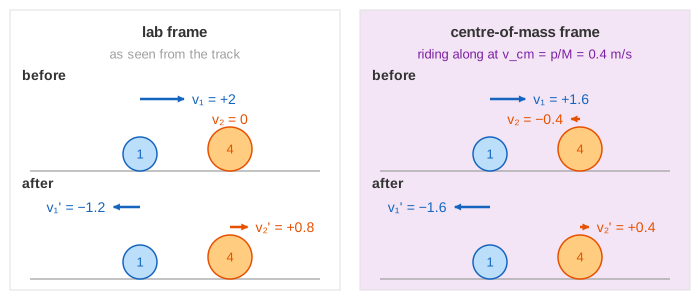
| m₁ ≪ m₂, ball 2 at rest | the light ball bounces back; the heavy one creeps forward | Demo 4: 1 kg on 4 kg → −1.2, 0.8 |
| m₂ → ∞ (a wall) | v₁' → −v₁, the wall does not move | Demo 5: m₂ = 100 → −1.96, 0.04 |
| p = 0 | each ball bounces straight back with its own speed | Demo 6: +3, −1 → −3, +1 |
A ball can also hit one that moves the same way, as long as it is faster (Demo 7: 3 m/s catches 1 m/s). If v₁ ≤ v₂ ball 1 never catches ball 2, and the page refuses to collide.
The centre-of-mass view
The centre of mass sits at (m₁x₁ + m₂x₂)/M and moves at v_cm = p/M. Because p never changes, neither does v_cm: on the x–t diagram the purple line stays straight through the collision while the blue and orange lines bend. Ride along with the centre of mass (subtract v_cm from every velocity) and the total momentum is 0. There an elastic collision is very simple: each ball just reverses its velocity. Add v_cm back and you have the answer in the lab.
Restitution e: bouncy and sticky collisions
Real balls lose some energy to heat, sound and dents. The coefficient of restitution e says how much of the closing speed comes back as opening speed: v₂' − v₁' = −e·(v₂ − v₁). Momentum is still kept, so
v₁' = (p − e·m₂·(v₁ − v₂)) / M v₂' = (p + e·m₁·(v₁ − v₂)) / MFor 1 kg at 2 m/s hitting 1 kg at rest (p = 2 kg·m/s, KE = 2 J before):
| e | name | v₁' | v₂' | KE after | lost |
|---|---|---|---|---|---|
| 1 | elastic | 0 | 2 | 2 J | 0 |
| 0.5 | inelastic | 0.5 | 1.5 | 1.25 J | 0.75 J (38%) |
| 0 | perfectly inelastic (sticky) | 1 | 1 | 1 J | 1 J (50%) — Demo 8 |
With e = 0 both balls end up moving at v_cm. That is the most energy a collision can lose: the kinetic energy of the centre-of-mass motion, ½·M·v_cm², can never be lost, because the momentum has to go somewhere.
See also
During the contact the balls squeeze like very stiff springs and push apart again; an elastic collision is half a swing of Spring Oscillator. Energy passing back and forth between two forms also drives the Simple Pendulum.
A bullet that sticks in a hanging block is the e = 0 case put to work: the Ballistic Pendulum turns the swing height back into the bullet's speed.
Glancing collisions, where the discs push only along the line of centres and momentum is kept in x and in y, are on Collisions in 2-D.
What the page leaves out
Glancing collisions in 2-D and 3-D (momentum is then kept as a vector, in each direction), spin and friction with the track, the short time the balls are actually squeezed together (here the contact is instant), speeds near the speed of light, and three or more balls touching at once (a real Newton's cradle). The page keeps masses from 0.5 to 100 kg and speeds from −3 to 3 m/s, and shortens the movie when a fast ball would roll off the track.