The idea: split gravity along the ramp
A block of mass m sits on a ramp tilted at an angle θ. Gravity pulls it straight down with its weight mg, but the block can only move along the ramp. So split mg into two parts: one along the slope and one straight into the ramp. The part into the ramp is cancelled by the ramp; the part along the slope is fought by friction. Who wins decides everything.
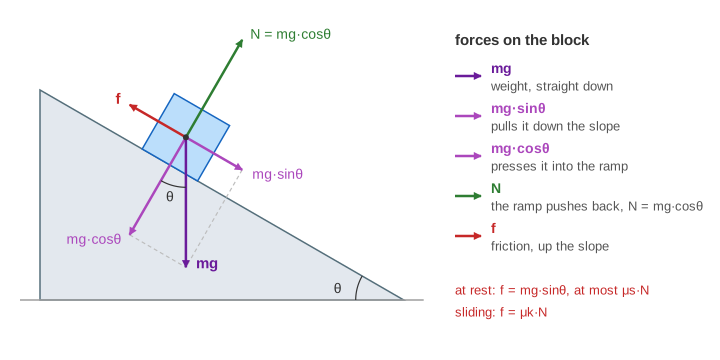
- Down the slope: mg·sinθ. Zero on flat ground, all of mg on a vertical wall.
- Into the ramp: mg·cosθ. All of mg on flat ground, zero on a wall.
The normal force N = mg·cosθ
The ramp pushes back on the block, at right angles to its surface. That push is the normal force N ("normal" means perpendicular). The block does not sink into the ramp or jump off it, so the forces across the ramp cancel: N = mg·cosθ. On a steeper ramp N gets smaller, and so does the friction the ramp can give, because friction is proportional to N.
Static friction: just enough, up to μs·N
A block at rest feels static friction. It is not a fixed force: it gives exactly what is needed to hold the block, f = mg·sinθ, but never more than μs·N, where μs is the coefficient of static friction. So the block stays when
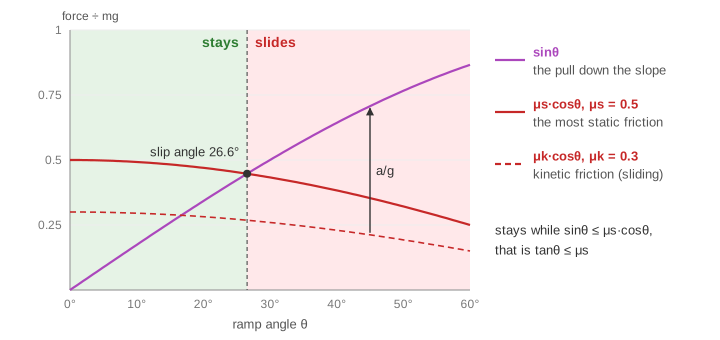
mg·sinθ ≤ μs·mg·cosθ ⇔ tanθ ≤ μsThe mass cancels, and the test is about the angle only. The angle where tanθ = μs is the slip angle (or angle of repose): with μs = 0.5 it is arctan 0.5 ≈ 26.6°. At 25° the block holds with 8.29 N of a possible 8.89 N (Demo 1); at 27° it slips (Demo 2). Tilting a board until a coin starts to slide is how μs is measured.
Sliding: kinetic friction and a = g(sinθ − μk·cosθ)
Once the block moves, friction is kinetic: a fixed f = μk·N up the slope, with μk usually smaller than μs. The net force down the slope is mg·sinθ − μk·mg·cosθ, and Newton's second law F = m·a gives
a = g·(sinθ − μk·cosθ)That a is constant, so from rest the distance along the ramp is x = ½·a·t² and the speed is v = a·t. The time to slide d = 4 m is t = √(2d/a). With the page's start values (θ = 30°, μk = 0.3): a = 9.81·(0.500 − 0.3·0.866) = 2.36 m/s², t = √(8/2.36) = 1.84 s, v = 4.34 m/s. Because kinetic friction is smaller than the static limit, a block that just breaks free jumps to a clear acceleration instead of creeping (Demo 2: 1.83 m/s² at 27°).
Special cases
| case | what happens | on the page |
|---|---|---|
| tanθ ≤ μs, at rest | static friction holds it: f = mg·sinθ, a = 0 | Demo 1: 25°, 8.29 N ≤ 8.89 N |
| no friction (μ = 0) | a = g·sinθ, the largest possible | Demo 3: 4.91 m/s², 1.28 s |
| any mass | every force is ∝ m, so a does not depend on m | Demo 4: 20 kg, still 2.36 m/s² |
| tanθ = μk, pushed | net force 0: constant speed | Demo 5: 45°, μk = 1, 4 m in 4 s |
| steep ramp | N is small, so friction matters less | Demo 6: 60°, 7.02 m/s², 1.07 s |
| tanθ < μk, pushed | a < 0: it slows and stops, then static friction holds it | Demo 7: stops at 1.51 m after 3.01 s |
A pushed block uses x = v₀t + ½at² with v₀ = 1 m/s. It stops after t = v₀/|a| at x = v₀²/(2|a|) when a is negative and that comes before the 4 m mark.
Typical friction coefficients
| surfaces | μs | μk |
|---|---|---|
| rubber on dry concrete | 1.0 | 0.7–0.8 |
| wood on wood | 0.25–0.5 | 0.2 |
| steel on steel (dry) | 0.6 | 0.4 |
| ice on ice | 0.1 | 0.03 |
These are rough values; real μ depends on how clean, wet and smooth the surfaces are. The page refuses μk > μs, because kinetic friction is (almost) never stronger than static friction.
See also
Gravity along a path and a mass that cancels also drive the Simple Pendulum, where the pull along the arc is mg·sinθ too. Momentum and energy when moving blocks hit each other: Elastic and Inelastic Collisions. A force that grows with distance instead of a constant one: Spring Oscillator.
What the page leaves out
Air drag, a block that rolls or tips over instead of sliding, friction that changes with speed or temperature, stick–slip juddering, a ramp that moves, pushing the block up the slope (friction then points down), and the energy view (mg·h turns into ½mv² plus heat f·d). The block is treated as a point for the forces, so every arrow starts at its centre; the slide is always 4 m along the ramp, and g = 9.81 m/s².