The idea: divide first
This page is about functions of the form
y = (ax² + bx + c) / (ex + f) (e ≠ 0)A quadratic over a linear term. Their graphs look complicated, but one long division splits every one of them into a straight line plus a simple fraction:
(ax² + bx + c) / (ex + f)  =  mx + k  +  R / (ex + f)

m = a/e      k = (be − af)/e²      R = a·x₀² + b·x₀ + c,   x₀ = −f/e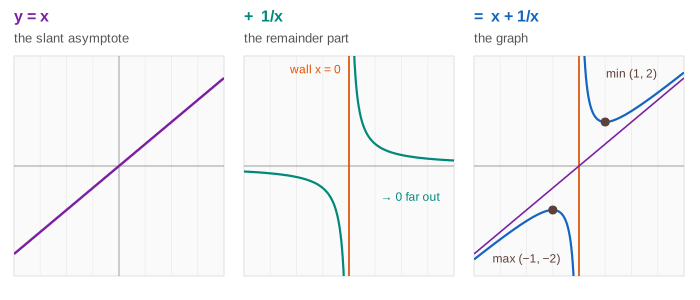
The line y = mx + k is the slant asymptote, the denominator gives the wall (vertical asymptote) x = x₀, and the remainder R says how strongly the graph bends away from them.
| coefficient | what it changes |
|---|---|
| a | the slope a/e of the slant asymptote (a = 0: flat, y = b/e) |
| b | the height of the slant asymptote: k changes by Δb/e |
| c | no asymptote at all, only the remainder R |
| e | the wall x = −f/e, and it divides everything (e = 0: no wall) |
| f | slides the wall x = −f/e |
e and f: the wall
The denominator ex + f is 0 at x₀ = −f/e. Near x₀ the fraction R/(ex + f) gets huge, so the graph shoots up on one side and down on the other: a vertical asymptote. f slides it: (x² + 1)/(x − 2) has its wall at x = 2, (x² + 1)/(x + 2) at x = −2. (Demo 1: f slides the wall) If e = 0 there is no wall at all: the denominator is the constant f and the graph is the parabola (ax² + bx + c)/f. (Demo 6: e = 0, no wall) e = f = 0 is not defined.
a and b: the slant asymptote
Far from the wall R/(ex + f) shrinks to 0, so the graph runs along y = mx + k. a/e is its slope: a = 2 makes it twice as steep, a = −1 tilts it the other way, and a = 0 makes it flat (y = b/e), turning the graph into a plain hyperbola like 1/x. (Demo 2: a tilts the slant asymptote) b lifts the line without tilting it: (x² + 2x + 1)/x = x + 2 + 1/x. (Demo 3: b lifts the slant asymptote) How to find the line by long division in general is on Types of Asymptotes and Polynomial Division.
c and the remainder: humps or not
c moves neither asymptote. It only changes the remainder R = N(x₀), the numerator at the wall. Put t = x − x₀:
y = mx + k + R/(e·t) y′ = m − R/(e·t²) = 0 ⇔ t² = R/a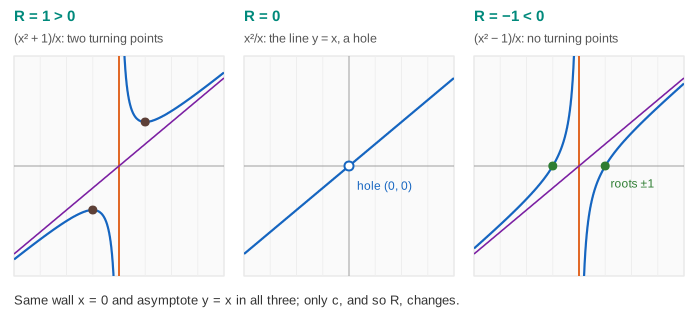
| R/a | the graph | example |
|---|---|---|
| > 0 | two turning points at x₀ ± √(R/a) | x + 1/x: min (1, 2), max (−1, −2) |
| = 0 (R = 0) | no wall: the line y = mx + k with a hole | x²/x = x, hole (0, 0) |
| < 0 | no turning points, each branch runs from the wall to the asymptote | x − 1/x, roots ±1 |
(Demo 4: c from 4 to −4 in steps of 0.1: on (x² + c)/x the remainder is R = c, so the two turning points (±√c, ±2√c) slide into the centre, the graph is the line y = x with a hole at c = 0, and after that the branches no longer turn back.)
Holes
R = 0 means the numerator is 0 at x₀, so x − x₀ is a factor of it and cancels with the denominator: (x² − x − 2)/(x − 2) = (x − 2)(x + 1)/(x − 2) = x + 1 for every x except 2. The graph is a line with one point missing, the hole (2, 3), not a wall. (Demo 5: a hole, the factor cancels)
Point symmetry about the centre
The two asymptotes cross at the centre (x₀, m·x₀ + k). Because R/(e·t) is an odd function of t, the graph is point-symmetric about the centre: turned 180° around it, it lands on itself. The max and the min are mirror images, the same as for a cubic around its inflection point (Cubic Functions: What a, b, c, d Do).
What the page leaves out
Denominators of degree 2 or more (two walls, horizontal asymptotes from comparing degrees), numerators of higher degree (curved asymptotes), sign charts and inequalities, and graphs that need a bigger window than x ∈ [−6, 6], y ∈ [−8, 8]. The same "one job per number" idea for other functions is on Quadratic, Cubic and Sine pages.