The idea: glue the most common pair together, again and again
A language model reads tokens, not letters or whole words. Letters make texts very long. Whole words need a huge vocabulary and still miss new words. Byte-pair encoding (BPE) sits in between. It starts from single characters and learns which pieces are common enough to deserve a token of their own.
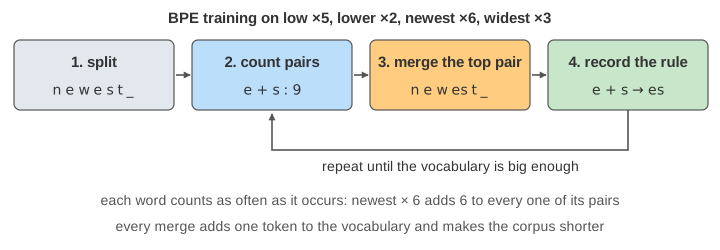
The canvas uses the classic example corpus: low ×5, lower ×2, newest ×6 and
widest ×3. Every word ends with the marker _ (written </w> in the
original paper), so the tokenizer can tell est at the end of a word from est in the middle.
Training: one merge at a time
- Count every pair of neighbouring tokens. A pair in
newestcounts 6 times, because the word occurs 6 times. - Pick the pair with the highest count.
- Merge: replace that pair everywhere in the corpus by one new token.
- Record the merge rule, for example
e + s → es, and add the new token to the vocabulary.
On this corpus the first merges are e + s (9), es + t (9) and est + _ (9):
the ending est_ is shared by newest and widest. Each merge makes the corpus
shorter: 95 → 86 → 77 → 68 tokens. (Demo 1: the first three merges)
Ties need a fixed rule
Two pairs often have the same count. In merge 4, l + o and o + w both have 7. Any fixed
rule works, but it must be the same every time, or two training runs on the same data give different tokenizers.
This page takes the pair it saw first when reading the corpus from the top. Libraries use their own rules, such as
the smallest pair in sort order. (Demo 2: a tie)
The vocabulary grows by one per merge
The vocabulary starts with the 11 symbols that appear in the corpus. Each merge adds exactly one token. This corpus allows 15 merges. After that every training word is a single token and no pair is left. The vocabulary then has 26 tokens. (Demo 3: the vocabulary grows to 26)
| Merges | Vocabulary | Corpus length | Last rule |
|---|---|---|---|
| 0 | 11 | 95 tokens | (characters only) |
| 3 | 14 | 68 tokens | est + _ → est_ |
| 8 | 19 | 36 tokens | new + est_ → newest_ |
| 15 | 26 | 16 tokens | lower + _ → lower_ |
Encoding a word: replay the rules in order
To tokenize new text, split each word into characters plus _. Then go through the merge rules
in the order they were learned and apply each one wherever it fits. The order matters: rule 2
(es + t) can only fire after rule 1 has made es. The resulting tokens are looked up in the
vocabulary, and the model gets their ids.
A training word such as newest comes out as one token, newest_
(Demo 4: encode a seen word). A word the tokenizer never saw is cut into pieces it knows:
lowest becomes low + est_, and newer becomes
new + e + r + _. (Demo 5: encode an unseen word)
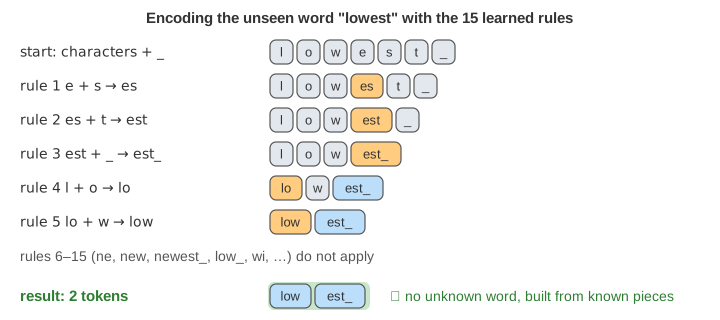
This is why BPE never has an "unknown word": in the worst case a word falls back to single characters. The model on the How a Large Language Model Works page uses a tokenizer like this.
Vocabulary size: the trade-off
More merges mean longer tokens, so the same text needs fewer of them. newest costs 7 tokens with no
merges, 4 after 4 merges (n e w est_) and 1 after 8. (Demo 6: more merges = fewer tokens)
| Small vocabulary | Large vocabulary | |
|---|---|---|
| Tokens per text | many (slower, uses more of the context window) | few |
| Embedding table | small | large (one row per token) |
| Rare tokens | each token is seen often in training | many tokens are rare and poorly learned |
Real tokenizers pick a target size and stop there: GPT-2 learned 50,000 merges on top of 256 byte values (50,257 tokens with one special token). Newer models use 100,000 to 200,000 tokens.
Real tokenizers
- Byte-level BPE (GPT-2 and later) starts from the 256 byte values instead of letters, so any text, emoji or language can be encoded.
- Pre-tokenization first splits text into words, numbers and punctuation with a regular
expression, and keeps the leading space with the word (
·the) instead of an end marker. - WordPiece (BERT) picks merges by a likelihood score instead of raw counts. Unigram (SentencePiece) starts big and removes tokens. Both still split rare words into pieces.
See also How a Large Language Model Works for what happens to the token ids next, Attention for how the model mixes tokens, and Huffman coding for another way to give frequent things short codes.
See also Word2Vec: once text is split into tokens, each token gets a learned embedding vector.
What the page leaves out
Bytes instead of letters, the pre-tokenization regex, special tokens such as <|endoftext|>,
fast training (real trainers update pair counts incrementally instead of recounting), encoding by merge rank with a
priority queue, and dropout variants of BPE. The corpus has 4 words; real tokenizers train on gigabytes of text.