The idea: a curve in 2D, a surface in 3D
In the plane, x2/a2 + y2/b2 = 1 is an ellipse: a curve. In space a point has three numbers (x, y, z), and the same equation says nothing about z. So z can be anything: if (x, y) is on the ellipse, then (x, y, z) is on the surface for every z. The ellipse is slid up and down the z-axis, and it sweeps out a tube, the elliptic cylinder.
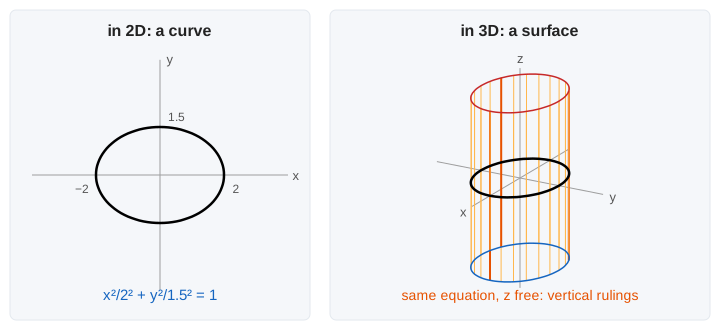
a and b are the semi-axes: the tube reaches x = ±a and y = ±b at every height. In general form the coefficients of z2, yz, zx and z are all 0. (Demo 1: build it: the ellipse slides along z)
Rulings: straight lines on a curved surface
Through every point (x0, y0, z0) of the cylinder runs the whole vertical line (x0, y0, t). These lines are the rulings. The cylinder is a ruled surface: a straight line moving along a curve (the directrix, here the ellipse) without turning. That is why a sheet of paper rolls into a cylinder without stretching.
Cut z = h: the same ellipse every time
Put z = h in. Nothing happens, because there is no z: the cut is x2/a2 + y2/b2 = 1 at every height. Slide the plane up or down and the black curve never changes. Compare the ellipsoid or a hyperboloid, where the cut grows or shrinks with h. (Demo 2: slide the cut z = h: nothing changes)
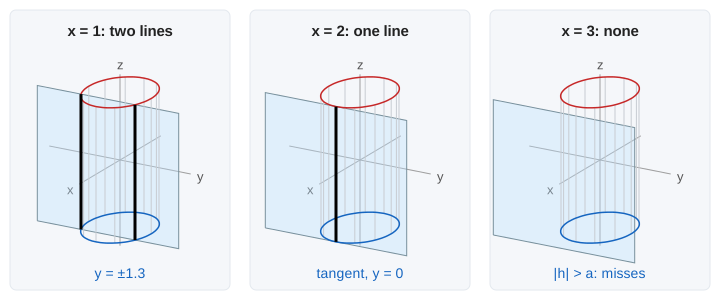
Cut x = h: two lines, one, none
Put x = h in: y2/b2 = 1 − h2/a2, and z is still free.
- |h| < a: the right side is positive, y = ±b√(1 − h2/a2). Two parallel vertical lines.
- |h| = a: y = 0. One line: the plane touches the cylinder along a ruling, a tangent plane.
- |h| > a: the right side is negative, no y works. The plane misses.
With a = 2, b = 1.5: x = 0 gives y = ±1.5, x = 1 gives y = ±1.3, x = 2 gives y = 0, x = 3 gives nothing. The cut y = h works the same way with a and b swapped. (Demo 3: cut x = h: two lines, one, none)
a = b: the circular cylinder
When a = b = r the equation is x2 + y2 = r2: every cut z = h is a circle of radius r, and the surface is the round circular cylinder of pipes and cans. The elliptic cylinder is a round one stretched along x or y. (Demo 4: a = b: a circular cylinder)
A tilted cut: a longer ellipse
Cut with the plane z = m·x, tilted about the y-axis. The points are (a cos t, b sin t, m·a cos t). Measured inside the plane, the distance along the slope is u = x√(1 + m2), so the cut is an ellipse with semi-axes a√(1 + m2) along the slope and b across it. The steeper the plane, the longer the ellipse. With a = 2, b = 1.5, m = 1: semi-axes 2.83 and 1.5. If a√(1 + m2) = b (a < b), the slanted cut is even a circle. (Demo 5: tilted cut z = m·x: a longer ellipse)
| cut | what you get (a = 2, b = 1.5) |
|---|---|
| z = h | the ellipse x2/22 + y2/1.52 = 1, for every h |
| x = h, |h| < 2 | two vertical lines y = ±1.5√(1 − h2/4) |
| x = ±2 | one vertical line (tangent plane) |
| x = h, |h| > 2 | nothing |
| y = h | the same with b = 1.5: two lines, one at ±1.5, none beyond |
| z = m·x | an ellipse, semi-axes 2√(1 + m2) and 1.5 |
See also
Quadric Surfaces shows all nine surfaces in one family. Hyperbolic Cylinder slides a hyperbola instead of an ellipse, and the Elliptic Cone shrinks the ellipse to a point as it moves. Turning the view is a 3D rotation.
What the page leaves out
Cylinders over other curves (the parabolic cylinder y = x2, any curve f(x, y) = 0), cylinders whose rulings are not parallel to an axis (a missing variable only after a rotation), cuts by planes tilted in other directions, and the area and volume of the cylinder.