The idea: one equation, nine shapes
A quadric surface is the set of points (x, y, z) that satisfy one equation of degree 2:
Ax2 + By2 + Cz2 + Dxy + Eyz + Fzx + Gx + Hy + Iz + J = 0
with A … J real numbers, not all zero. It is the 3D version of a conic section (Ax2 + Bxy + Cy2 + Dx + Ey + F = 0): there a slice of a cone, here a whole surface.
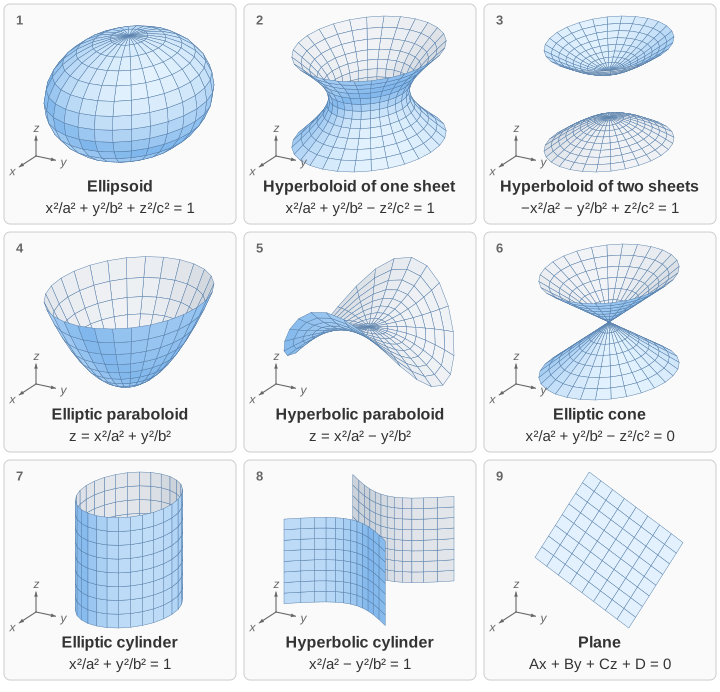
Ten coefficients sound like endless shapes, but they are not. A rotation of the axes removes the cross terms Dxy, Eyz, Fzx, and a translation (completing the square) removes most of the linear terms Gx, Hy, Iz. What is left is a standard form, and there are only nine that are real surfaces (a, b, c > 0 everywhere below). (Demo 1: tour of the nine surfaces)
| surface | standard form | trace z = h | pieces |
|---|---|---|---|
| ellipsoid | x2/a2 + y2/b2 + z2/c2 = 1 | ellipse for |h| < c, a point at ±c, nothing beyond | 1, closed |
| hyperboloid of one sheet | x2/a2 + y2/b2 − z2/c2 = 1 | ellipse for every h, smallest at h = 0 | 1 |
| hyperboloid of two sheets | −x2/a2 − y2/b2 + z2/c2 = 1 | nothing for |h| < c, a point at ±c, ellipse beyond | 2 |
| elliptic paraboloid | z = x2/a2 + y2/b2 | ellipse for h > 0, a point at 0, nothing below | 1 |
| hyperbolic paraboloid | z = x2/a2 − y2/b2 | hyperbola; two crossing lines at h = 0 | 1 |
| elliptic cone | x2/a2 + y2/b2 − z2/c2 = 0 | ellipse growing with |h|, a point at 0 | 1 (two nappes meeting at the tip) |
| elliptic cylinder | x2/a2 + y2/b2 = 1 | the same ellipse for every h | 1 |
| hyperbolic cylinder | x2/a2 − y2/b2 = 1 | the same hyperbola for every h | 2 |
| plane | Ax + By + Cz + D = 0 | a line (or the whole plane, or nothing) | 1 |
Each surface has its own page with more cuts and demos: click its name in the table.
Reading the signs
Put the squares on the left and the constant on the right. Then the shape is in the signs:
- + + + = 1: all three squares add up to 1, so none can be big. The surface is closed and bounded: an ellipsoid.
- + + − = 1: one minus sign. x and y can grow as long as z grows too. One connected tube: the hyperboloid of one sheet.
- − − + = 1: two minus signs. z2/c2 must be at least 1, so |z| ≥ c and the gap between −c and c is empty. Two pieces: the hyperboloid of two sheets.
- + + − = 0: right side 0. The origin is on the surface and every point can be scaled towards it: the cone.
- One variable to the first power (z instead of z2): a paraboloid. Same signs → bowl, opposite signs → saddle.
- One variable missing: a cylinder. The missing variable can be anything, so the surface is a 2D curve pushed straight along that axis.
Which variable carries the odd sign only says which axis the surface opens along. x2 − y2 + z2 = 1 is still a hyperboloid of one sheet, but around the y-axis.
a, b, c stretch the surface
a, b and c are scales along x, y and z. In the ellipsoid they are the semi-axes: the surface meets the axes at (±a, 0, 0), (0, ±b, 0) and (0, 0, ±c). Doubling a stretches the whole surface twice as far along x and leaves y and z alone. a = b = c is a sphere of radius a; a = b ≠ c is a spheroid, round from above (an egg when c > a, a flattened disc when c < a). (Demo 2: a, b, c stretch the ellipsoid) In the other surfaces a and b set the size of the traces and c how fast they change with height. The same "one job per number" idea for curves is on Ellipse and Hyperbola.
Traces: slice with z = h
A 3D surface is hard to read from a formula. A trace is easier: cut the surface with a plane and look at the curve. With the plane z = h, put h in for z and you get a 2D conic in x and y. For the hyperboloid of one sheet:
x2/a2 + y2/b2 = 1 + h2/c2
The right side is always ≥ 1, so every slice is an ellipse, smallest at h = 0 (the neck) and growing both ways. (Demo 4: slice the hyperboloid, h from −2 to 2) Slices x = 0 and y = 0 tell the rest: here y2/b2 − z2/c2 = 1, a hyperbola, which gives the surface its name. The ellipsoid's traces are all ellipses, the saddle's are hyperbolas and parabolas.
The k-family: one sheet, cone, two sheets
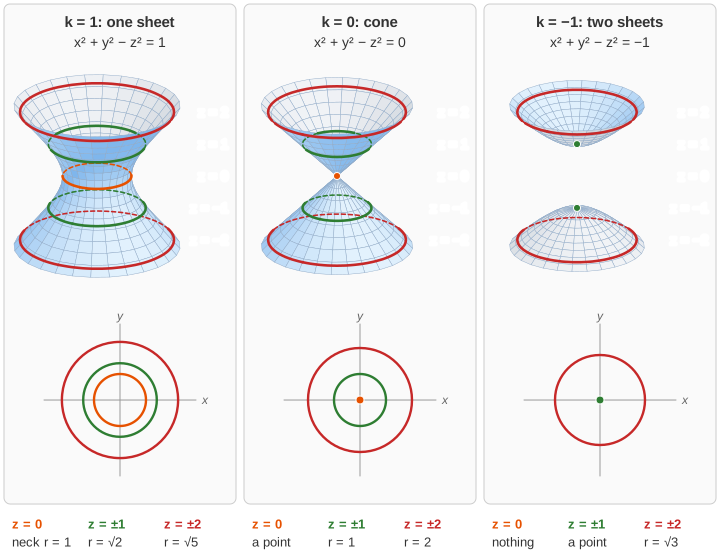
Three of the nine are one equation with a different right side:
x2/a2 + y2/b2 − z2/c2 = k
| k | surface | trace z = 0 |
|---|---|---|
| > 0 (k = 1) | hyperboloid of one sheet | an ellipse: the neck |
| = 0 | elliptic cone | one point: the tip |
| < 0 (k = −1) | hyperboloid of two sheets | nothing: the gap |
Slide k down from 1 and the neck pinches; at k = 0 it closes to a point and the surface is the cone; below 0 it tears into two sheets that move apart. Far from the origin all three hug the same cone, the asymptotic cone, just as a hyperbola hugs its asymptotes. (Demo 3: k from 1 to −1: one sheet → cone → two sheets) Between the sheets a slice finds nothing: for k = −1 the trace z = h is empty while |h| < c. (Demo 6: two sheets, nothing in between)
Paraboloids and cylinders
In z = x2/a2 + y2/b2 the right side is never negative, so the surface sits above z = 0: an open bowl, the elliptic paraboloid. Its traces z = h are ellipses for h > 0, and the slices x = 0 and y = 0 are parabolas (Parabola).
In z = x2/a2 − y2/b2 the two terms pull opposite ways. Along x the surface is a parabola opening up, along y one opening down: the hyperbolic paraboloid or saddle. The origin is a saddle point, neither a top nor a bottom. Its traces z = h are hyperbolas, opening along x for h > 0 and along y for h < 0, and at h = 0 two lines y = ±(b/a)x that cross. (Demo 5: saddle traces at h = 1, 0, −1)
When a variable is missing, as z in x2/a2 + y2/b2 = 1, the equation does not care what z is. Every slice z = h is the same ellipse, stacked into an elliptic cylinder. x2/a2 − y2/b2 = 1 stacks a hyperbola into a hyperbolic cylinder: two curved walls. (Demo 7: cylinder, z is missing)
Where you meet them
- Ellipsoid: the Earth (a spheroid flattened at the poles), a rugby ball, the "whispering gallery" domes where a sound at one focus is heard at the other.
- Hyperboloid of one sheet: power-station cooling towers and lattice towers. Through every point pass two straight lines that lie on the surface, so it can be built from straight beams.
- Elliptic paraboloid (round, a = b): satellite dishes, car headlights, telescope mirrors. Rays parallel to the axis all reflect through one point, the focus.
- Hyperbolic paraboloid: Pringles chips and saddle roofs. It also contains two families of straight lines.
- Cone and cylinder: funnels, pipes, tanks. Slicing a cone at different angles gives every conic section.
From the general form to a standard form
Two moves turn any quadric into a standard form.
1. Rotate to remove Dxy, Eyz, Fzx. The second-degree part is a symmetric matrix:
| x | y | z | |
|---|---|---|---|
| x | A | D/2 | F/2 |
| y | D/2 | B | E/2 |
| z | F/2 | E/2 | C |
A symmetric matrix has three perpendicular eigenvectors. Turn the axes to point along them (a 3D rotation) and the cross terms vanish; the new coefficients of u2, v2, w2 are the three eigenvalues λ1, λ2, λ3. Their signs already tell the family: all the same sign → ellipsoid (or a point, or nothing); two of one sign and one of the other → hyperboloid or cone; one eigenvalue 0 → paraboloid or cylinder.
2. Shift to remove Gx, Hy, Iz. Complete the square in each variable whose square is still there, then move the origin to the centre (changing coordinates, completing the square).
Example: 5x2 − 6xy + 5y2 + 4z2 − 8z − 4 = 0. Here D = −6, so the matrix has rows (5, −3, 0), (−3, 5, 0), (0, 0, 4) and eigenvalues 2, 8 and 4. Turn the x- and y-axes by 45°: u = (x + y)/√2, v = (y − x)/√2. Then 5x2 − 6xy + 5y2 = 2u2 + 8v2. Complete the square in z: 4z2 − 8z = 4(z − 1)2 − 4. Together:
2u2 + 8v2 + 4(z − 1)2 = 8, that is, u2/4 + v2/1 + (z − 1)2/2 = 1
an ellipsoid with semi-axes a = 2, b = 1, c = √2, centred at (0, 0, 1) and turned 45° about the z-axis.
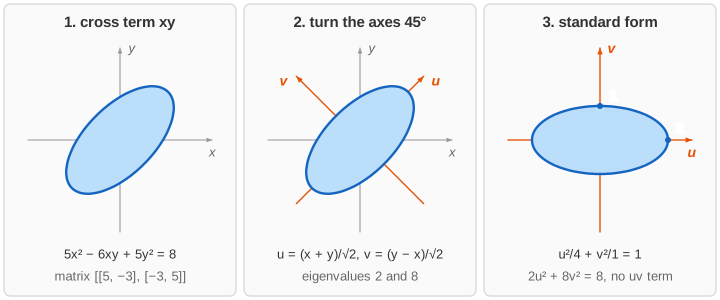
The same move in 2D, for conics, is on Conic Sections.
Six worked examples, with the eigenvector arrows and the turn animated, are on Quadric Classification. Spinning a conic about an axis gives several of these surfaces directly: see Surfaces of Revolution; and the cuts z = h laid flat side by side are a contour map: see Level Curves and Contour Maps.
The plane
If A = B = C = D = E = F = 0, all the second-degree terms are gone and the equation is Gx + Hy + Iz + J = 0, written Ax + By + Cz + D = 0: a plane. (A, B, C) is its normal vector, and D shifts it along that normal. Its traces z = h are straight lines. It is the degenerate member of the family: a quadric with no quadratic part.
Beyond degree 2, Surfaces by Degree puts planes, quadrics, cubics and quartics side by side. The cubics have their own pages, Monkey Saddle, Cubic Surface and Cayley's Nodal Cubic, and so do the quartics, Quartic Surface and Kummer Surface.
What the page leaves out
The degenerate and empty cases: x2/a2 + y2/b2 + z2/c2 = −1 (the imaginary ellipsoid, no points), the parabolic cylinder y = ax2, pairs of planes (x2 = y2), a single line or point. Also the full classification by the rank and signs of the 4 × 4 matrix with the linear terms, and quadrics in projective space.