The idea: one equation, two pieces
The hyperboloid of two sheets is the set of points (x, y, z) with
−x2/a2 − y2/b2 + z2/c2 = 1
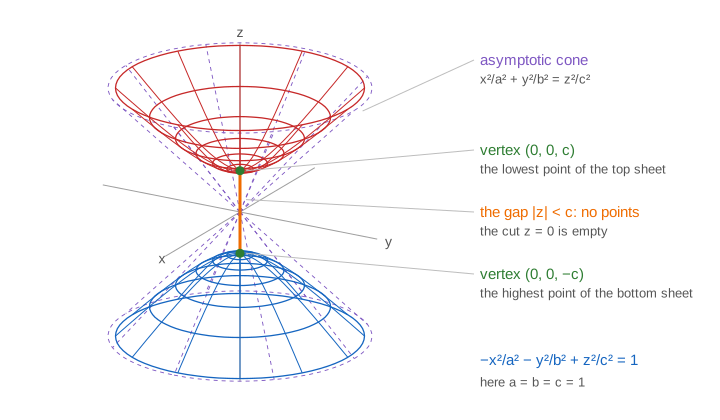
(a, b, c > 0). Two squares carry a minus sign, one a plus. Unlike most surfaces you meet, it is not one piece: it is two separate sheets, a bowl opening up and a bowl opening down, with empty space between them.
The gap and the vertices
Move the minus terms to the right side:
z2/c2 = 1 + x2/a2 + y2/b2 ≥ 1
So every point has |z| ≥ c. The slab −c < z < c holds no point at all: that is the gap, and it is why the surface falls apart into two pieces. The closest points to the gap are where x = y = 0: the two vertices (0, 0, c) and (0, 0, −c). c alone decides where they sit. (Demo 1: c moves the vertices)
Horizontal cuts z = h: nothing, a point, an ellipse
Put z = h into the equation:
x2/a2 + y2/b2 = h2/c2 − 1
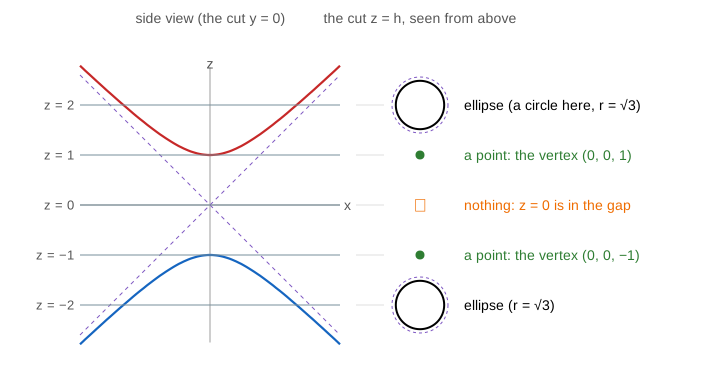
- |h| < c: the right side is negative, a sum of squares cannot be. No points: the plane passes through the gap.
- |h| = c: the right side is 0, so x = y = 0. One point, the vertex: the plane just touches a sheet.
- |h| > c: an ellipse with semi-axes a√(h2/c2 − 1) along x and b√(h2/c2 − 1) along y. It grows as the plane moves away from the gap; a = b makes it a circle.
With a = 1.5, b = 1, c = 1 and h = 2: h2/c2 − 1 = 3, so the cut is x2/6.75 + y2/3 = 1, semi-axes 2.6 and 1.73. (Demo 2: slide the cut z = h through the gap)
Vertical cuts x = h and y = h: always a hyperbola
Put x = h instead:
z2/c2 − y2/b2 = 1 + h2/a2
The right side is at least 1 for every h, so the cut is always a hyperbola opening along z (up and down), with its two branches on the two sheets. Its vertices sit at z = ±c√(1 + h2/a2): at x = 0 they are the surface's own vertices, and they move away as the plane moves off the axis. y = h works the same way with a and b swapped. These hyperbolas give the surface its name. (Demo 3: cut x = h is always a hyperbola)
The asymptotic cone
Replace the 1 on the right by 0:
x2/a2 + y2/b2 = z2/c2
That is an elliptic cone with its tip at the origin, in the middle of the gap. Far from the vertices the 1 hardly matters, so the sheets get closer and closer to this asymptotic cone without touching it, just as a hyperbola approaches its asymptotes. At height h the sheet's cut has semi-axis a√(h2/c2 − 1) along x and the cone's a|h|/c; the difference shrinks toward 0 as |h| grows. In the cut x = 0 the cone gives the two lines z = ±(c/b)y, exactly the asymptotes of the hyperbola there. (Demo 4: the asymptotic cone) The cone itself has its own page: Elliptic Cone.
What a, b and c do
c places the vertices at (0, 0, ±c), so it sets the height of the gap, 2c. a and b set how fast the bowls open: far out, |x| ≈ (a/c)|z| along x and |y| ≈ (b/c)|z| along y, the slopes of the cone. Big a, b give wide, flat bowls; small a, b give narrow ones. a = b makes the surface round about the z-axis (a hyperboloid of revolution). (Demo 5: a and b open the bowls)
| fact | value |
|---|---|
| pieces | 2 (z ≥ c and z ≤ −c) |
| vertices | (0, 0, c) and (0, 0, −c) |
| cut z = h | none for |h| < c, a point at h = ±c, an ellipse for |h| > c |
| cut x = h, y = h | always a hyperbola opening along z |
| asymptotic cone | x2/a2 + y2/b2 = z2/c2 |
| bounded | no |
| symmetric in | the planes x = 0, y = 0, z = 0 and the origin |
One sheet, cone, two sheets
Write it as x2/a2 + y2/b2 − z2/c2 = k with k = −1. For k = 1 the same left side gives the connected Hyperboloid of One Sheet, for k = 0 the cone; all three share the same asymptotic cone. The page Quadric Surfaces slides k from 1 to −1 and shows the neck pinch to a point and split.
Two sheets show up where a distance difference is fixed: rotate a hyperbola about the axis through its foci and you get a hyperboloid of two sheets, the set of points whose distances to the two foci differ by a constant. In special relativity the points at a fixed proper time from an event (t2 − x2 − y2 = const) form one, and its upper sheet is a model of the hyperbolic plane.
What the page leaves out
Hyperboloids turned or shifted away from the axes (general form with cross and linear terms), two sheets opening along x or y (the minus signs on other squares), tangent planes, and the hyperboloid model of hyperbolic geometry beyond one sentence.