The idea: three squares that add up to 1
An ellipsoid is the set of points (x, y, z) with
x2/a2 + y2/b2 + z2/c2 = 1, a, b, c > 0.
All three terms are squares, so none is negative. They add up to 1, so none can be bigger than 1. That is the whole story: the surface is closed (no edge, no opening) and bounded (it fits in a box). It is the 3D version of the ellipse x2/a2 + y2/b2 = 1.
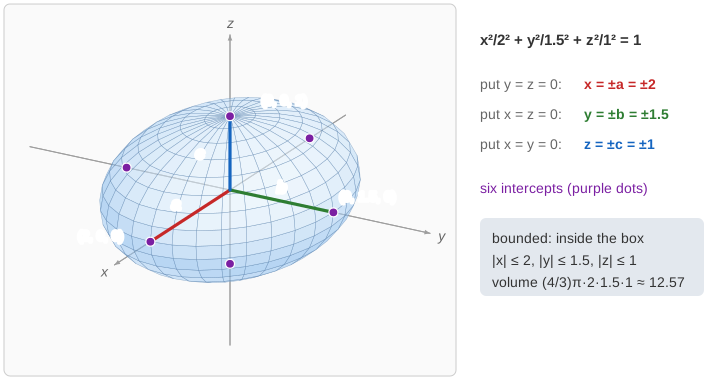
a, b, c are the semi-axes
Put y = z = 0 in the equation: x2/a2 = 1, so x = ±a. The surface meets the x-axis at (±a, 0, 0), the y-axis at (0, ±b, 0) and the z-axis at (0, 0, ±c). These six points are the intercepts (the purple dots on the canvas), and a, b, c are the semi-axes: half the length of the ellipsoid along each axis. Change one and the surface stretches along that axis only. (Demo 1: a, b, c are the semi-axes)
Another way to see it: the ellipsoid is the unit sphere u2 + v2 + w2 = 1 stretched by a along x, b along y and c along z (x = au, y = bv, z = cw).
Sphere, prolate and oblate spheroids
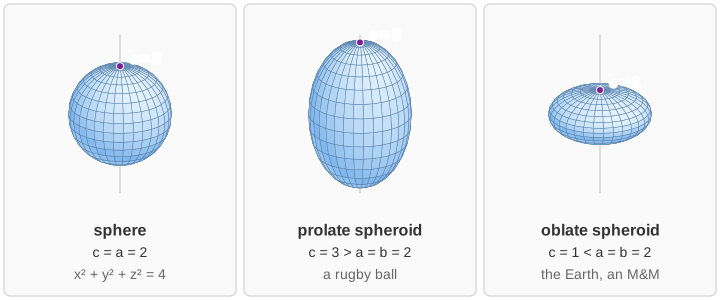
Which semi-axes are equal decides the shape:
| semi-axes | shape | looks like |
|---|---|---|
| a = b = c = r | sphere x2 + y2 + z2 = r2 | a ball |
| a = b < c | prolate spheroid | a rugby ball, an egg standing up |
| a = b > c | oblate spheroid | the Earth, an M&M |
| a, b, c all different | triaxial ellipsoid | a pebble |
With a = b every cut z = h is a circle, so the spheroid is round about the z-axis: it is what you get by spinning an ellipse about one of its axes. Spin it about the long axis and you get the prolate one, about the short axis the oblate one. (Demo 2: sphere → prolate → oblate spheroid)
Cuts: ellipses that shrink to a point
Cut with the plane z = h: put h in for z and move it to the right side.
x2/a2 + y2/b2 = 1 − h2/c2
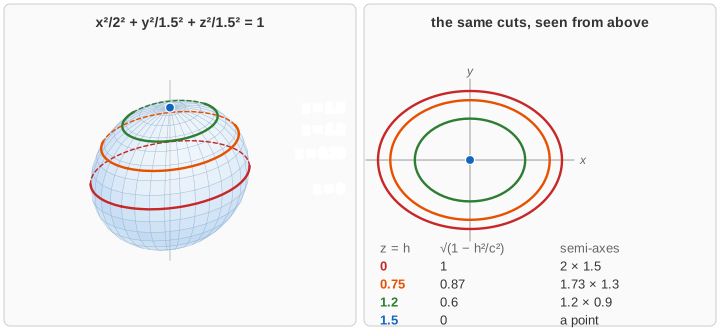
- |h| < c: the right side is positive. Divide by it and the cut is an ellipse with semi-axes a√(1 − h2/c2) and b√(1 − h2/c2). It is biggest at h = 0 (semi-axes a and b) and shrinks as |h| grows.
- |h| = c: the right side is 0, so x = y = 0. The cut is one point, the top (0, 0, c) or the bottom (0, 0, −c).
- |h| > c: the right side is negative and two squares cannot add up to it. The plane misses the surface. (Demo 5: cut beyond c finds nothing)
Both semi-axes are multiplied by the same factor √(1 − h2/c2), so every cut z = h has the same shape (the ratio a : b) and only its size changes. For a = 2, b = 1.5, c = 1.5 at h = 1 the factor is √(1 − 1/2.25) ≈ 0.75 and the cut has semi-axes 1.49 and 1.12. (Demo 3: slide the cut z = h from −c to c)
The other two axes work the same way. The cut x = h is the ellipse y2/b2 + z2/c2 = 1 − h2/a2 in the y-z plane, a point at x = ±a, nothing beyond. (Demo 4: cut x = h, from −a to a) The cut y = h gives x2/a2 + z2/c2 = 1 − h2/b2.
| cut | ellipse while | semi-axes | point at |
|---|---|---|---|
| x = h | |h| < a | b√(1 − h2/a2), c√(1 − h2/a2) | x = ±a |
| y = h | |h| < b | a√(1 − h2/b2), c√(1 − h2/b2) | y = ±b |
| z = h | |h| < c | a√(1 − h2/c2), b√(1 − h2/c2) | z = ±c |
Bounded, and its volume
Each square is at most 1, so |x| ≤ a, |y| ≤ b, |z| ≤ c: the ellipsoid sits inside the box 2a × 2b × 2c. It is the only quadric surface that is closed and bounded.
Stretching the unit ball by a, b and c multiplies every volume by abc, so the volume is V = (4/3)πabc; for a sphere, (4/3)πr3. The start state a = 2, b = 1.5, c = 1.5 has V = (4/3)π · 4.5 ≈ 18.85. There is no such simple formula for the surface area unless two semi-axes are equal.
Facts at a glance
| property | value |
|---|---|
| equation | x2/a2 + y2/b2 + z2/c2 = 1 |
| intercepts | (±a, 0, 0), (0, ±b, 0), (0, 0, ±c) |
| centre, symmetry | the origin; symmetric in each of the three coordinate planes |
| cuts parallel to a coordinate plane | ellipse, a point, or nothing |
| bounded | yes: |x| ≤ a, |y| ≤ b, |z| ≤ c |
| volume | (4/3)πabc |
| general form | x2/a2 + y2/b2 + z2/c2 − 1 = 0: three positive squares, constant −1 |
See also Quadric Surfaces for all nine shapes, Hyperboloid of One Sheet (flip the sign of z2) and Elliptic Cylinder (drop z2).
See also Cubic Surface, where raising two exponents of the sphere to 3 turns a bounded surface into one that runs off to infinity.
What the page leaves out
Tilted ellipsoids (cross terms xy, yz, zx; the overview page shows how a rotation removes them) and shifted ones ((x − x0)2/a2 + …). Cuts by tilted planes, which are also ellipses, and the two families of circular cuts of a triaxial ellipsoid. The surface area (elliptic integrals), the imaginary ellipsoid x2/a2 + y2/b2 + z2/c2 = −1 with no points, and uses such as the reference ellipsoid of the Earth (WGS 84) and the covariance ellipsoid in statistics.