The idea: one square and two cubes
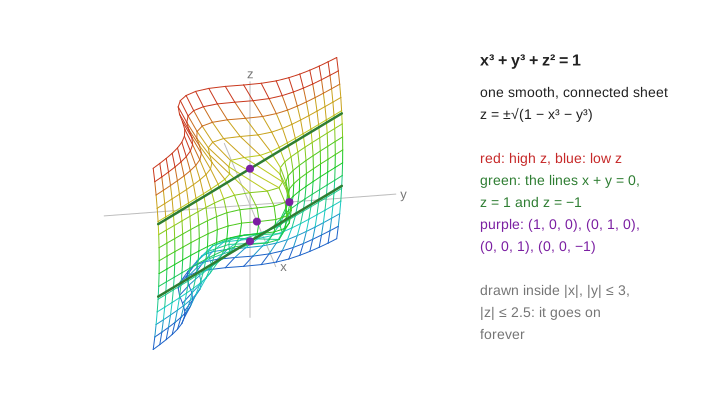
The cubic surface on this page is the set of points (x, y, z) with
x3 + y3 + z2 = c (the page starts with c = 1).
It looks like the sphere x2 + y2 + z2 = 1 with two exponents raised from 2 to 3, and that small change makes a very different shape. The highest power is 3, so it is a surface of degree 3, one step beyond the quadric surfaces of degree 2. Solve for z:
z = ±√(c − x3 − y3).
So the surface has a top half (+) and a bottom half (−) that are mirror images in the plane z = 0, and it is a mirror image of itself in the plane x = y too, because x and y can swap.
Where it lives: the region x³ + y³ ≤ c
A square root needs a number that is not negative, so the surface sits over the region x3 + y3 ≤ c of the x-y plane. Its edge is the curve x3 + y3 = c, where z = 0 and the top and bottom halves meet.
Factor the left side: x3 + y3 = (x + y)(x2 − xy + y2). The second factor is never negative, so x3 + y3 has the sign of x + y. For c ≥ 0 the region holds the whole half plane x + y ≤ 0 and a bit more. That region is not bounded, and over it c − x3 − y3 grows without limit, so the surface climbs as high as we like.
It meets the axes at (∛c, 0, 0), (0, ∛c, 0) and (0, 0, ±√c): for c = 1 at (1, 0, 0), (0, 1, 0) and (0, 0, ±1), the purple dots on the canvas.
Cuts z = h: Fermat-type cubic curves
Put z = h and move h2 to the right:
x3 + y3 = c − h2.
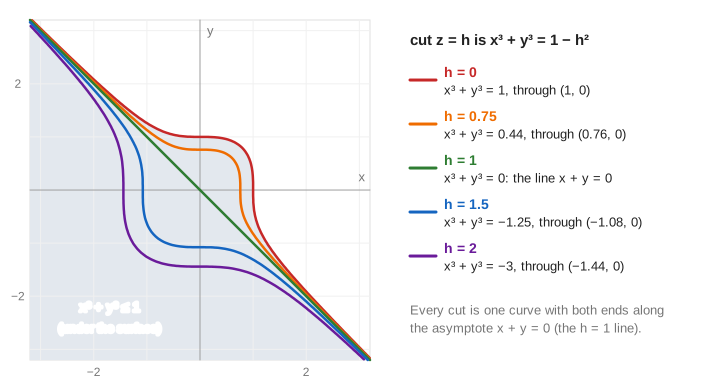
This is a Fermat-type cubic x3 + y3 = k with k = c − h2. Unlike an ellipsoid's cut, it is never empty: for every x there is exactly one y = ∛(k − x3). For large x, y ≈ −x, so both ends of every cut follow the asymptote x + y = 0.
| height | k = c − h2 | the cut |
|---|---|---|
| |h| < √c | k > 0 | a curve on the side x + y > 0, through (∛k, 0) and (0, ∛k) |
| |h| = √c | k = 0 | the straight line x + y = 0 |
| |h| > √c | k < 0 | a curve on the side x + y < 0, through (∛k, 0) and (0, ∛k) |
For c = 1: at h = 0 the cut x3 + y3 = 1 goes through (1, 0) and (0, 1); at h = 0.75 it is x3 + y3 = 0.44 through (0.76, 0); at h = 1 it is the line; at h = 1.5 it is x3 + y3 = −1.25 through (−1.08, 0); at h = 2 it is x3 + y3 = −3 through (−1.44, 0). (Demo 1: slide the cut z = h from 0 to 2)
Two straight lines on a cubic surface
At h = ±√c the right side is 0, and (x + y)(x2 − xy + y2) = 0 only when x + y = 0 (the second factor is 0 only at the origin). So the surface contains the two straight lines x + y = 0, z = ±√c, the green lines on the canvas. Along them the height stays the same forever. (Demo 2: at h = ±√c the cut is a straight line)
For c < 0, c − h2 is never 0 and the lines are gone; for c = 0 the two lines meet in one, at z = 0.
Squares vs cubes: why it runs off to infinity
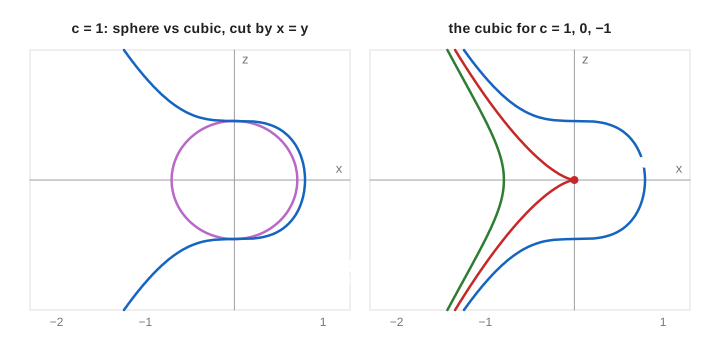
In x2 + y2 + z2 = c every term is a square, so none is negative and none can be bigger than c: |x|, |y|, |z| ≤ √c and the sphere is bounded. A cube keeps the sign of its number: (−2)3 = −8. So x3 + y3 can be as negative as we like, and z2 = c − x3 − y3 as large as we like. The cubic surface is unbounded. Pick "compare: sphere" to draw both; at z = 2 the sphere has no cut but the cubic still has a whole curve. (Demo 4: squares vs cubes: the sphere stays bounded)
The clearest view is the cut by the plane x = y. There x3 + y3 = 2x3, so the profile is 2x3 + z2 = c, while the sphere's profile is the circle 2x2 + z2 = c. The circle closes up; the cubic profile x = ∛((c − z2)/2) keeps going to x → −∞ as z grows.
Three branches?
Drawings of this surface are sometimes called a "three-branch cylinder" (Vietnamese: mặt trụ ba nhánh). The equation does not give three separate pieces. For every point (t, z), with t measured across the line x = y, there is exactly one point of the surface, so it is one connected, smooth sheet: a curved wall along x + y = 0. What can look like branches are the directions in which this sheet runs off: the two ends along the asymptote x + y = 0, and the trough that opens toward x = y → −∞ above and below. It is also not a cylinder: a cylinder has the same cut at every height, and here the cut changes with h. A picture with three arms is a stylised drawing. (Demo 5: turn the view: one sheet, not three branches)
The right side c, and the sharp point at c = 0
Change c and the wall moves: the axis points ∛c and ±√c move with it. The shape stays a smooth sheet except at c = 0. Then the origin lies on the surface and the gradient (3x2, 3y2, 2z) is the zero vector there, so the surface has a singular point: a sharp point where no tangent plane fits. In the plane x = y the profile is z2 = −2x3, a cusp. For c < 0 the origin is off the surface, it misses the z-axis, and every cut lies on the side x + y < 0. (Demo 3: c → 0 gives a sharp point)
Facts at a glance
| property | x3 + y3 + z2 = c | sphere x2 + y2 + z2 = c |
|---|---|---|
| degree | 3 | 2 |
| bounded | no | yes, |x|, |y|, |z| ≤ √c |
| cut z = h | always a cubic curve x3 + y3 = c − h2 (a line at |h| = √c) | a circle for |h| < √c, a point, then nothing |
| straight lines on it | x + y = 0, z = ±√c | none |
| symmetry | z ↔ −z, x ↔ y | every rotation about the origin |
| c = 0 | a sharp point at the origin | only the origin |
| c < 0 | a smooth sheet that misses the z-axis | no points |
See also Quadric Surfaces for the degree-2 shapes, Ellipsoid for the bounded sphere family, Level Curves for stacking cuts z = h into a contour map, and Cubic Function for what x3 does in one variable. Other surfaces beyond quadrics: the monkey saddle, the Cayley cubic, the Kummer surface and the quartic x4 + y4 − z4 = 1, all side by side on Surfaces by Degree.
What the page leaves out
Cuts by other planes (x = h gives y3 + z2 = c − h3, a cubic curve of the elliptic-curve type), the general cubic surface with all twenty terms, and the famous fact that a smooth cubic surface in complex projective space holds exactly 27 straight lines (this one shows only the two real lines in view). Also left out: how the drawing solves the equation (in s = (x + y)/√2, t = (x − y)/√2 it becomes s3 + 3t2s = √2(c − z2), one real s for each t and z), curvature, and the points at infinity.