The idea: sort surfaces by the degree of their equation
An algebraic surface is the set of points (x, y, z) where a polynomial is zero: F(x, y, z) = 0. Its degree is the degree of F. Degree 1 gives the flat planes, degree 2 the quadrics (sphere, ellipsoid, paraboloid, hyperboloid, cone), degree 3 the cubic surfaces and degree 4 the quartic surfaces. Each step up allows more bends, more pieces and more pinch points.
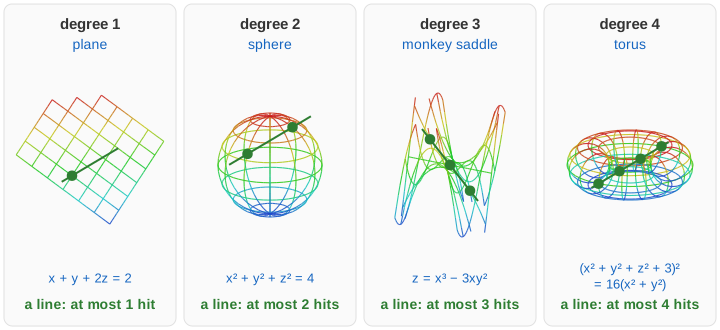
Pick a surface in the first menu (grouped by degree). The wireframe is drawn straight from F: ten slices z = const and ten slices x = const, each traced where F changes sign. Red is high, blue is low. (Demo 1: one surface per degree)
What "degree" means
The degree of a term is the sum of its exponents: x3 and 3xy2 have degree 3, and so does xyz (1 + 1 + 1). The degree of F is the largest degree of any of its terms. Expanding (x2 + y2 + z2 + 3)2 gives x4, so the torus has degree 4 even though no x4 is written.
| degree | surface on the page | F(x, y, z) = 0 | nodes | bounded |
|---|---|---|---|---|
| 1 | plane | x + y + 2z = 2 | 0 | no |
| 2 | sphere | x2 + y2 + z2 = 4 | 0 | yes |
| 2 | ellipsoid | x2/9 + y2/4 + z2 = 1 | 0 | yes |
| 2 | paraboloid | z = (x2 + y2)/2 | 0 | no |
| 2 | hyperboloid | x2 + y2 − z2 = 1 | 0 | no |
| 2 | cone | x2 + y2 = z2 | 1 | no |
| 3 | monkey saddle | z = x3 − 3xy2 | 0 | no |
| 3 | a cubic with z2 | x3 + y3 + z2 = 1 | 0 | no |
| 3 | Cayley's nodal cubic | 4(x2 + y2 + z2) + 16xyz = 1 | 4 | no |
| 4 | torus, R = 2, r = 1 | (x2 + y2 + z2 + 3)2 = 16(x2 + y2) | 0 | yes |
| 4 | Kummer surface, μ2 = 2 | (x2 + y2 + z2 − 2)2 = 5pqrs | 16 | no |
| 4 | a quartic hourglass | x4 + y4 − z4 = 1 | 0 | no |
The quadrics have their own overview, Quadric Surfaces, with all nine standard forms. The pages Monkey Saddle, Cubic Surface and Cayley's Nodal Cubic go deeper into the cubics, and Kummer Surface and Quartic Surface into the quartics.
A line meets a degree-n surface in at most n points
Write a line as x = p + t·d: each of x, y, z is a number plus a multiple of t. Put that into F. Every term of degree k becomes a polynomial of degree at most k in t, so F along the line is a polynomial of degree at most n in t. A polynomial of degree n has at most n real roots, and every root is a point where the line meets the surface.
For the torus and the x-axis (y = z = 0): (t2 + 3)2 = 16t2, that is, t4 − 10t2 + 9 = 0, with roots t = ±1 and ±3. The x-axis goes into the tube at −3, out at −1, across the hole, in at 1 and out at 3: four hits, the most a quartic allows. (Demo 2: a line meets degree n in at most n points)
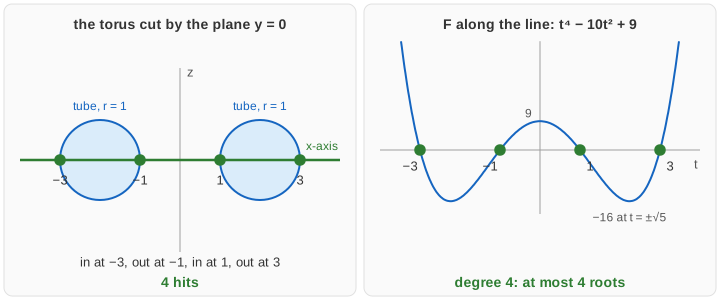
Fewer hits are normal: some roots are complex, or two roots meet where the line only touches the surface. The bound fails only when F is zero for every t, that is, when the whole line lies on the surface. The cone and the hyperboloid contain straight lines, and a smooth cubic surface contains 27 of them (counted with complex ones; up to 27 can be real).
The cut z = h is a curve of degree ≤ n
Put z = h into F and what is left is a polynomial in x and y alone: a plane curve of degree at most n. For the monkey saddle it is x3 − 3xy2 = h, a cubic curve with three branches; at h = 0 it splits into three lines, x(x − √3y)(x + √3y) = 0. (Demo 3: monkey saddle cuts h = 1, 0, −1) For the torus, a quartic, the cut is two circles, then one circle where the plane rests on top of the tube, then nothing. (Demo 4: torus cuts: two circles, one, none)
The degree can drop. In Cayley's cubic the only degree-3 term is 16xyz, and z = h turns it into 16h·xy, which has degree 2. So every horizontal cut of that cubic is a conic: an ellipse for |h| < ½, a doubled line at h = ±½ and a hyperbola beyond. Stacking cuts like this is how the level curves of a contour map work.
Nodes: 1, 4, 16
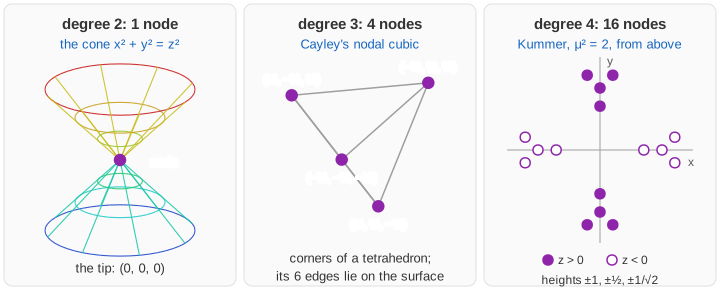
A node is a point of the surface where the gradient of F is zero as well, so the surface has no tangent plane there. Near a node it looks like the tip of a double cone. Degree limits how many isolated nodes a surface can have:
- Degree 2: at most 1, the tip of the cone x2 + y2 = z2.
- Degree 3: at most 4. Cayley's nodal cubic has them at (½, ½, −½), (½, −½, ½), (−½, ½, ½) and (−½, −½, −½), the corners of a regular tetrahedron. The cut z = ½ is the line x = −y through two of them. (Demo 5: Cayley's cubic, 4 nodes)
- Degree 4: at most 16. Kummer's surface (x2 + y2 + z2 − μ2)2 − λpqrs = 0, with λ = (3μ2 − 1)/(3 − μ2) and the four planes p, q = 1 − z ∓ √2x, r, s = 1 + z ± √2y, reaches it. The page uses μ2 = 2, λ = 5, where all 16 nodes are real points: they sit at the heights z = ±1, ±½ and ±1/√2, four of them at each of ±1/√2 and two at each other height. (Demo 6: Kummer's quartic, 16 nodes)
For degree 5 the record is 31 (Togliatti's quintic), for degree 6 it is 65 (Barth's sextic). Finding the maximum for higher degrees is still an open problem. The monkey saddle is not a node: as a surface it is smooth everywhere. Its origin is a degenerate critical point of the function x3 − 3xy2, which is a different idea.
A picture often labelled "Cayley's cubic" shows x3 + y3 + z3 − 3xyz = 0. That one factors: x3 + y3 + z3 − 3xyz = (x + y + z)(x2 + y2 + z2 − xy − yz − zx). The second factor is ½((x − y)2 + (y − z)2 + (z − x)2), which is zero only on the line x = y = z. So its real points are just the plane x + y + z = 0 plus one line through it, not a curved surface. The page uses the true nodal cubic instead.
Bounded or not
A surface is bounded if it fits inside some ball. The sphere, the ellipsoid and the torus are; the others run off to infinity. A quick test: if the highest-degree part of F is positive in every direction (x2 + y2 + z2, or (x2 + y2 + z2)2 for the torus), then F is large and positive far away and cannot be zero there. An odd degree never passes this test: x3 is negative in one direction and positive in the other, so a real cubic surface is never bounded.
What the page leaves out
Surfaces in projective space, where the counts become exact (a line meets a degree-n surface in exactly n points, counted with multiplicity, including complex and infinite ones). The 27 lines on a smooth cubic, the classification of singularities beyond simple nodes, and degrees above 4. The wireframe shows only the part of each surface inside its box, and it is drawn from slices, so very thin parts between slices can be missed.