The idea: one point and one line
Take a point F, the focus, and a line, the directrix. The points that are exactly as far from F as from the line form a parabola:
|PF| = |PD| (D = the foot of the perpendicular from P to the directrix)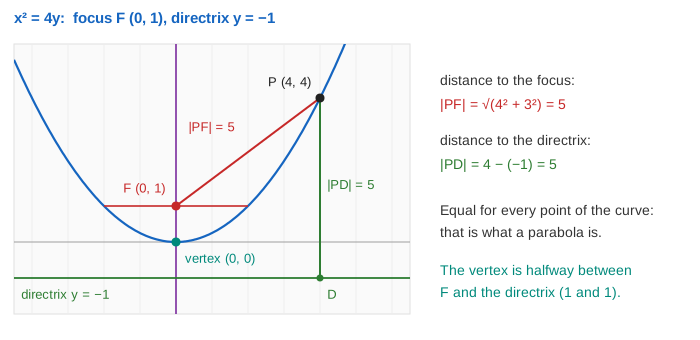
Put the vertex at (h, k) and let p be the signed distance from the vertex to the focus. Writing |PF| = |PD| out and squaring gives the equation the page uses:
(x − h)² = 4p(y − k)

vertex (h, k) focus (h, k + p) directrix y = k − p axis x = h| number | what it changes |
|---|---|
| p | the focal length: vertex to focus, and vertex to directrix; the width |4p|; its sign flips the parabola |
| h | slides everything sideways (the axis of symmetry is x = h) |
| k | slides everything up and down |
| axis | vertical (x − h)² = 4p(y − k) or horizontal (y − k)² = 4p(x − h) |
Why the equation is (x − h)² = 4p(y − k)
With the vertex at the origin the focus is (0, p) and the directrix is y = −p. For a point P = (x, y):
|PF|² = x² + (y − p)²        |PD|² = (y + p)²

x² + y² − 2py + p² = y² + 2py + p²   ⇒   x² = 4py
Moving the vertex to (h, k) replaces x by x − h and y by y − k. The vertex lies halfway between the focus and the directrix, so it is the point of the parabola closest to both. (Demo 3: every point, |PF| = |PD| walks a point P along x² = 4y and shows both distances: 5, 3.25, 2, 1.25, 1, … at x = −4, −3, …, 0.)
p: the focal length and the width
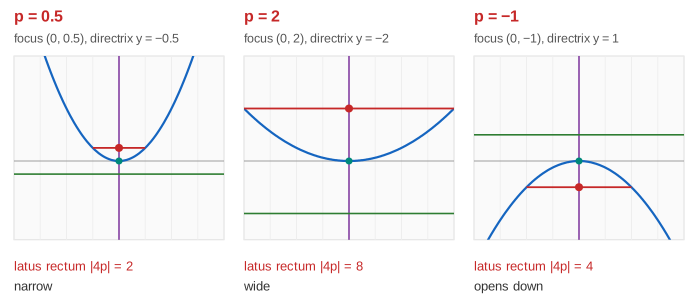
The chord through the focus parallel to the directrix is the latus rectum. Its ends are where y = k + p, so (x − h)² = 4p², x = h ± 2p: it is |4p| long. A small |p| puts the focus close to the vertex and makes a narrow parabola, a big |p| a wide one. A negative p puts the focus below the vertex and the directrix above it: the parabola opens down. (Demo 1: p moves the focus, sets the width)
p = 0 is not a parabola
With p = 0 the focus sits on the vertex and the directrix passes through it, so the only points as far from both are on the axis: (x − h)² = 0 is the line x = h. (Demo 2: p from 2 to −2 in steps of 0.1: the parabola gets narrower and narrower, collapses onto the line x = 0 at p = 0, then opens downward and widens again.)
h and k slide it
h and k do not change the shape at all: vertex, focus, directrix and axis all move together. (x − 3)² = 4(y + 2) is x² = 4y moved 3 right and 2 down: vertex (3, −2), focus (3, −1), directrix y = −3. (Demo 4: h and k slide it)
Sideways parabolas
Swap the roles of x and y and the parabola opens right (p > 0) or left (p < 0):
(y − k)² = 4p(x − h) focus (h + p, k) directrix x = h − p axis y = kThis is not a function of x (one x has two y values), which is why y = ax² + bx + c can't describe it. (Demo 6: sideways turns x² = 4y about its vertex and then flips it to y² = −4x, focus (−1, 0), directrix x = 1.)
a = 1/(4p): the link to y = ax² + bx + c
Solve the vertical form for y:
y = (1/(4p))·(x − h)² + k so a = 1/(4p), p = 1/(4a)Every y = ax² + bx + c is a parabola with focal length 1/(4a): y = x² has its focus at (0, ¼). (x − 1)² = 2(y + 2) is y = ½(x − 1)² − 2 = 0.5x² − x − 1.5. (Demo 7: a = 1/(4p)) What a, b and c do to that form is on What a, b and c Do to a Parabola; completing the square to get the vertex form is on Quadratic Equations.
The reflection property: dishes and headlights
A ray from the focus that hits the parabola bounces off (angle in = angle out against the tangent) and leaves parallel to the axis, wherever it hits. So a lamp at the focus of a parabolic mirror makes a straight beam (headlights, torches), and run backwards, light or radio waves coming in parallel to the axis all meet at the focus (satellite dishes, radio telescopes, solar cookers). (Demo 5: a headlight)
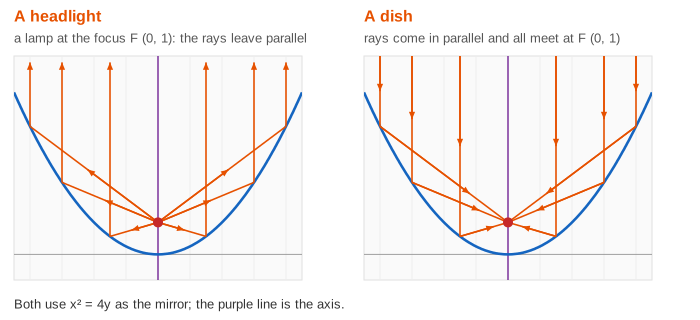
Why: the tangent at P makes equal angles with PF and with the line from P straight to the directrix, because P is as far from F as from D, so the tangent is the perpendicular bisector of FD.
One of the conic sections
|PF| = e·|PD| with a fixed ratio e, the eccentricity, gives every conic: e < 1 an ellipse, e = 1 a parabola, e > 1 a hyperbola. The parabola is the borderline case, which is why it has only one focus and never closes. The same "what each number does" view of the others is on Ellipse and Hyperbola.
Multiply out and a parabola becomes Ax² + Bxy + Cy² + Dx + Ey + F = 0 with B² − 4AC = 0, the boundary between ellipses and hyperbolas. How the six numbers pick the type and the turn is on Conic Sections: What A, B, C, D, E, F Do.
What the page leaves out
Tilted parabolas (an xy term, axes other than vertical and horizontal), the parametric form (2pt, pt²), tangent lines and their equations, the area under a parabola, and parabolas that need a window bigger than x ∈ [−8, 8], y ∈ [−7, 7]. The path of a thrown ball is a parabola only without air resistance.