The idea: a box and its diagonals
This page is about the hyperbola
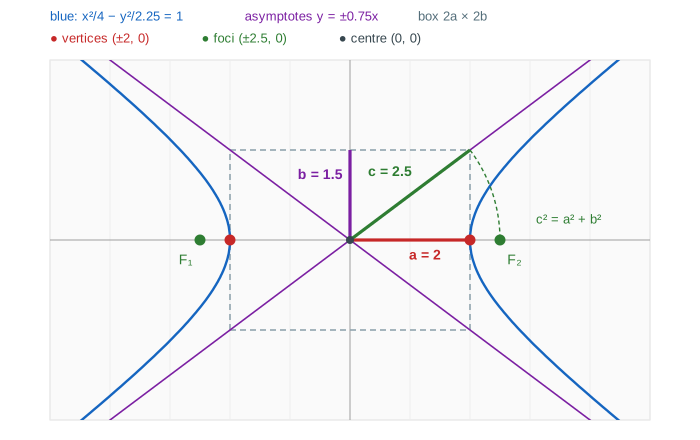
(x − h)²/a² − (y − k)²/b² = 1 (a, b > 0)Four numbers, one job each. Draw a box 2a wide and 2b tall around the centre (h, k). Its two diagonals are the asymptotes, the lines the curve gets closer and closer to. The two branches start at the middle of the left and right sides of the box, the vertices (h ± a, k), and bend out towards the diagonals.
| number | what it changes |
|---|---|
| h | slides the hyperbola left or right (the centre is (h, k)) |
| k | slides it up or down |
| a | half the width of the box: the vertices (h ± a, k), where the branches start |
| b | half the height of the box: with a, the asymptote slopes ±b/a |
| ±1 | the right side: −1 swaps the two terms, and the hyperbola opens up and down |
a and b: where it starts, how wide it opens
Put y = k into the equation: (x − h)²/a² = 1, so x = h ± a. These two points are the vertices, the points of each branch closest to the centre. There is nothing between them: for |x − h| < a the left side is smaller than 1 whatever y is. So a says where the branches start. (Demo 2: a moves the vertices)
Far from the centre the 1 hardly matters, and the equation is almost (x − h)²/a² = (y − k)²/b², the two lines y − k = ±(b/a)(x − h). Those are the diagonals of the box. A taller box (bigger b) or a narrower one (smaller a) makes them steeper and the branches open wider. (Demo 3: b from 0.5 to 4 in steps of 0.1: with a = 2 the vertices stay at (±2, 0) while the slopes go from ±0.25 to ±2.)
c² = a² + b²: the foci
The two foci sit on the same line as the vertices, at (h ± c, k) with
c² = a² + b² (ellipse: c² = a² − b²)c is the half-diagonal of the box, so the foci are always outside the box, inside the branches. For the start x²/4 − y²/2.25 = 1: c = √(4 + 2.25) = 2.5. Compare the ellipse on Ellipse: What h, k, a, b Do, where the foci are inside and c² = a² − b².
Eccentricity e = c/a > 1
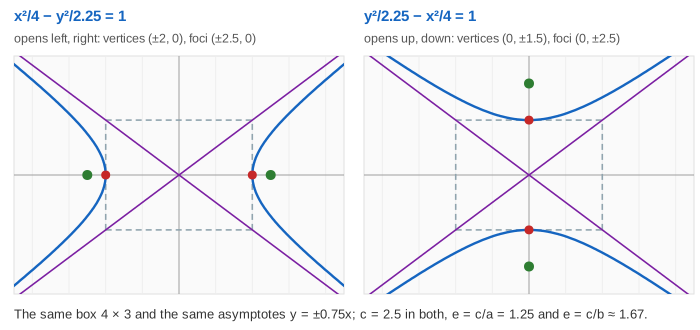
The eccentricity is e = c/a = √(1 + b²/a²). Because c > a it is always more than 1 (a circle has e = 0, an ellipse 0 < e < 1, a parabola e = 1, see Parabola). e close to 1 means narrow branches hugging the line through the vertices; a large e means a wide-open hyperbola with steep asymptotes. e depends only on b/a, so scaling a and b together keeps the shape. In Demo 3, e goes from about 1.03 to 2.24.
|PF₁ − PF₂| = 2a
This is the definition of a hyperbola: the points P whose distances to two fixed points differ by a constant. For every point of the curve, the difference is 2a, the distance between the vertices.
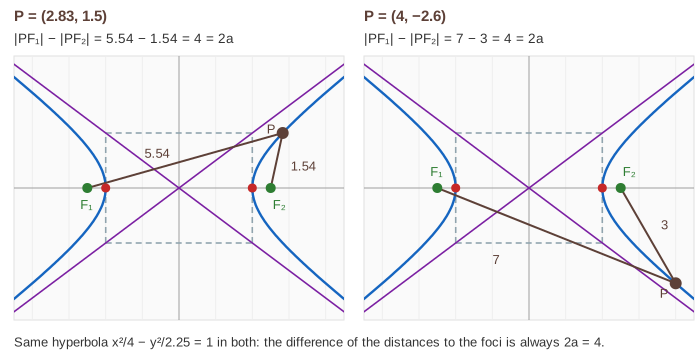
At the right vertex (2, 0) of the start: |PF₁| = 2 + 2.5 = 4.5 and |PF₂| = 2.5 − 2 = 0.5, difference 4. At (2.83, 1.5) the two distances are 5.54 and 1.54, again 4. (Demo 5: |PF₁ − PF₂| = 2a moves P around, then changes a to 3: the difference becomes 6.) The ellipse has the same idea with a sum: PF₁ + PF₂ = 2a.
a = b: the rectangular hyperbola
When a = b the box is a square, its diagonals have slopes ±1 and meet at right angles. This is the rectangular hyperbola, with c = a√2 and e = √2 ≈ 1.41. (Demo 4: a = b) The graph of y = 1/x is one too, turned 45° so that its asymptotes are the axes: xy = 1 (see the hyperbola on Rational Functions: What a, b, c, e, f Do).
h and k slide it
Replacing x by x − h moves every point h to the right; replacing y by y − k moves it k up. The centre, box, asymptotes, vertices and foci all slide together, and a, b, c and e do not change. (Demo 1: h and k slide it: centre (2, −1), vertices (0, −1) and (4, −1), foci (−0.5, −1) and (4.5, −1).)
−1: opens up and down
Put −1 on the right side and multiply by −1:
(x − h)²/a² − (y − k)²/b² = −1 ⇔ (y − k)²/b² − (x − h)²/a² = 1Now the y-term is the positive one, so the branches open up and down. This is the conjugate hyperbola: the same box and the same asymptotes, but the vertices are (h, k ± b), the foci (h, k ± c) with the same c² = a² + b², e = c/b, and |PF₁ − PF₂| = 2b. On the way from 1 to −1 the page passes through 0, where the equation factors into the two asymptotes. (Demo 6: −1 on the right)
The general form
Multiply out and everything sits on one side:
b²x² − a²y² − 2b²h·x + 2a²k·y + (b²h² − a²k² − a²b²) = 0
x²/4 − y²/2.25 = 1   →   2.25x² − 4y² − 9 = 0
Read backwards: an equation Ax² + Cy² + Dx + Ey + F = 0 with A and C of opposite signs is a hyperbola (or its pair of asymptotes). Completing the square in x and in y, as on Quadratic Equations, brings it back to the form with h, k, a, b.
Multiply out and every hyperbola becomes Ax² + Bxy + Cy² + Dx + Ey + F = 0 with B² − 4AC > 0; 1/x is one turned by 45°. How the six numbers pick the type and the turn is on Conic Sections: What A, B, C, D, E, F Do.
What the page leaves out
Rotated hyperbolas (an xy term, like xy = 1), the directrices x = h ± a²/c and the focus–directrix definition, the reflection property of the foci, tangent lines, the parametric form x = h ± a cosh t, y = k + b sinh t, and hyperbolas too big for the window x ∈ [−8, 8]. Asymptotes of other curves are on Types of Asymptotes; the same "one job per number" idea for the other conics is on Ellipse and Parabola.