The idea: a volume is a sum of slices
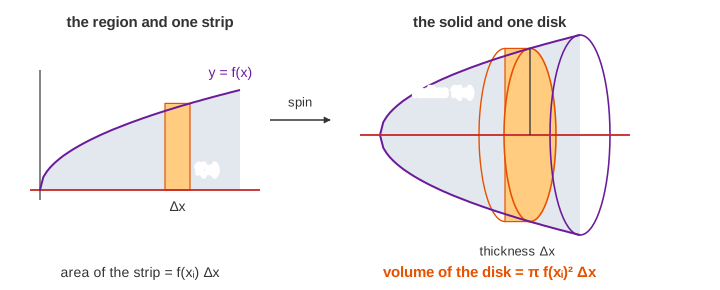
An integral is not only an area. It adds up anything that can be cut into thin slices. Take the region under y = f(x) on [a, b] and spin it about the x-axis: it sweeps out a solid of revolution. Cut [a, b] into n slices of width Δx. Each thin strip of the region spins into a thin disk: its radius is the strip's height f(xi) and its thickness is Δx. A disk is a short cylinder, so its volume is π f(xi)² Δx. Adding the disks gives an estimate of the volume, and as Δx shrinks the sum becomes an integral.
The disk method
V ≈ Σ π f(xi)² Δx, and in the limit V = ∫ab π f(x)² dx. It is a Riemann sum like the one for area, with π f(x)² (the area of the cross-section) in place of f(x). The canvas shows the 2-D profile on the left and the 3-D solid next to it, drawn at the same height, so each strip lines up with its disk. The page uses the right end xi of each slice.
Example: spin y = √x on [0, 4] about the x-axis. The solid is a paraboloid of radius 2 and length 4. With n = 4 the slices are 1 wide and the radii are √1, √2, √3, √4, so the sum is π(1 + 2 + 3 + 4) · 1 = 10π ≈ 31.4159. The exact volume is ∫04 π x dx = 8π ≈ 25.1327. Press Build to stack the disks one quarter at a time, then Double n. (Demo: paraboloid by disks, n = 4 → 32)
How fast the estimate gets better
| n | Paraboloid, disks | Paraboloid, shells | Sphere, disks |
|---|---|---|---|
| 4 | 31.4159 (+6.2832) | 23.5619 (−1.5708) | 31.4159 (−2.0944) |
| 8 | 28.2743 (+3.1416) | 24.7400 (−0.3927) | 32.9867 (−0.5236) |
| 16 | 26.7035 (+1.5708) | 25.0346 (−0.0982) | 33.3794 (−0.1309) |
| 32 | 25.9181 (+0.7854) | 25.1082 (−0.0245) | 33.4776 (−0.0327) |
For the paraboloid's disks the error halves each time n doubles: it is exactly 8π/n, error ∝ 1/n. The radius grows along the axis, so the right end is the widest point of each slice and every disk sticks out of the solid. The other two columns quarter instead (error ∝ 1/n²). There the slice volume is 0 at both ends (a sphere's disk at x = ±2, a shell at radius 0 or at the rim), so the right sum gives the same answer as the trapezoid rule, which is second order. See Riemann sums for the same ÷2 vs ÷4 pattern on areas.
The shell method
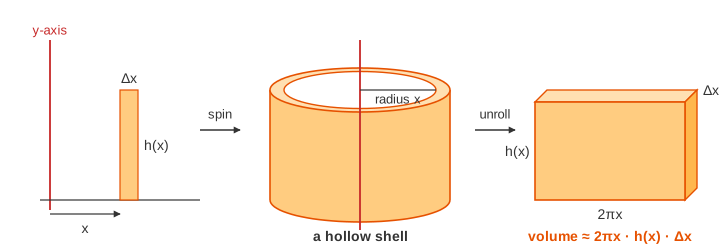
Now spin a region about the y-axis instead. A vertical strip at distance x from the axis, of height h(x) and width Δx, sweeps out a hollow cylinder, a cylindrical shell. Cut the shell open and unroll it: it is almost a flat slab, 2πx long, h(x) high and Δx thick. So V ≈ Σ 2π xi h(xi) Δx and V = ∫ 2π x h(x) dx.
The paraboloid stood upright is the region under y = 4 − x² on [0, 2] spun about the y-axis. Shells give ∫02 2πx(4 − x²) dx = 2π(8 − 4) = 8π, the same as the disks. Disks cut the solid across the axis, shells cut it into nested tubes around the axis; the volume does not care how it is sliced. Shells are the easy choice when the strip parallel to the axis has a simple height, for example when solving y = f(x) for x would be hard. (Demo: disks vs shells, both 8π)
Cone, sphere and paraboloid
| Solid (radius r, height h) | Disks: f(x) | Integral | Volume |
|---|---|---|---|
| Cone | (r/h) x on [0, h] | ∫ π r²x²/h² dx | ⅓ πr²h |
| Paraboloid | r √(x/h) on [0, h] | ∫ π r² x/h dx | ½ πr²h |
| Sphere | √(r² − x²) on [−r, r] | ∫ π(r² − x²) dx | 4/3 πr³ |
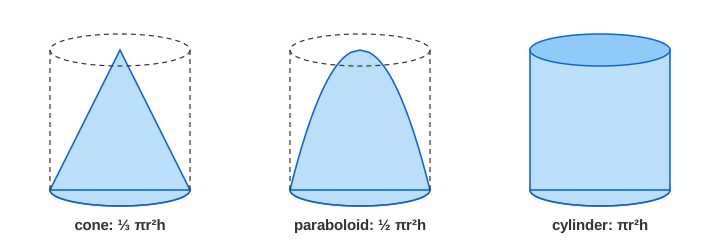
On the canvas r = 2 and h = 4: the cone is 16π/3 ≈ 16.7552, the paraboloid 8π ≈ 25.1327, the sphere 32π/3 ≈ 33.5103. The cylinder around a cone or paraboloid holds πr²h, so a cone fills a third of it and a paraboloid half. Archimedes found the sphere's volume by slicing: the sphere is two thirds of the cylinder around it. (Demo: cone = ⅓πr²h by disks, Demo: cone by shells, Demo: sphere = 4/3 πr³, disks and shells)
From sums to the integral
The disks and shells are Riemann sums, so their limits are integrals, and the Fundamental Theorem of Calculus evaluates them exactly: ∫04 πx dx = πx²/2 from 0 to 4 = 8π. The same "slice, approximate, add, take the limit" pattern gives arc length, surface area, mass from a density and work. See also accumulation, integration techniques (to evaluate harder volume integrals) and improper integrals (Gabriel's horn: infinite surface area, finite volume).
What the page leaves out
Washers (a region with a hole, V = ∫ π(R² − r²) dx), rotating about a line other than an axis, solids with square or triangular cross-sections (V = ∫ A(x) dx for any cross-section area A), the midpoint and other sample points, and a real 3-D rendering: the solid is drawn in a simple oblique view where circles become ellipses, and rims are drawn only for n ≤ 8.