The idea: an integral over an infinite region is a limit
A definite integral ∫ab f(x) dx needs a finite interval and a finite function. An improper integral drops one of those: the interval runs to infinity, or the function shoots up to infinity at an end. We handle it with a limit of ordinary integrals: ∫1∞ f(x) dx means the limit of ∫1B f(x) dx as B → ∞. If the limit is a finite number the integral converges to it; otherwise it diverges. The surprise is that an infinitely long region can have a finite area.
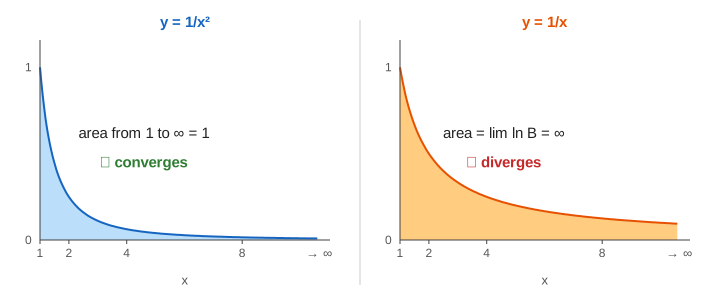
Doubling B: ln 2 every time vs a shrinking series
The antiderivatives give the running totals directly:
| Integral | From 1 to B | As B → ∞ |
|---|---|---|
| ∫ 1/x² dx | 1 − 1/B | 1 (converges) |
| ∫ 1/x dx | ln B | ∞ (diverges) |
The canvas pushes B = 2, 4, 8, …, 1024 and shades one strip [B/2, B] per push. Under 1/x every strip has area ln B − ln(B/2) = ln 2 ≈ 0.6931: the strip is twice as wide as the last one and half as tall, so its area never shrinks, and adding the same amount forever gives ∞. Under 1/x² the strip has area 1/B: each one is half the last, a geometric series ½ + ¼ + ⅛ + … = 1. At B = 1024 the table reads 0.9990 and 6.9315. ln B does grow without bound, just very slowly: it passes 100 only when B ≈ 2.7 × 1043. (Demo: 1/x² converges, 1/x diverges)
The x-axis is a log scale: every doubling of B gets the same width, and the axis compresses as B grows. On a normal axis the far strips would be thinner than a pixel.
The p-test
The same calculation for any power gives the p-test: ∫1∞ 1/xp dx converges exactly when p > 1, and then equals 1/(p − 1). Each strip is 21−p times the last one, so for p > 1 the strips form a shrinking geometric series and for p ≤ 1 they do not shrink. p = 1 is the borderline, and it already diverges.
| p | ∫11024 1/xp dx | ∫1∞ | ∫01 1/xp dx |
|---|---|---|---|
| 0.5 (1/√x) | 62.0000 | ∞ | 2 |
| 1 (1/x) | 6.9315 | ∞ | ∞ |
| 1.5 | 1.9375 | 2 | ∞ |
| 2 | 0.9990 | 1 | ∞ |
| 3 | 0.5000 | 0.5 | ∞ |
(Demo: p-test, p = 1.5 converges to 2 and Demo: p-test, p = 0.5 diverges.) The p-test is the yardstick for the comparison test: if 0 ≤ f(x) ≤ 1/x² for large x, then ∫ f converges too; if f(x) ≥ 1/x ≥ 0, it diverges. The same series ∑ 1/np converges for the same p, which is the integral test for series; see Taylor series for series that converge to a function.
Infinite height near 0
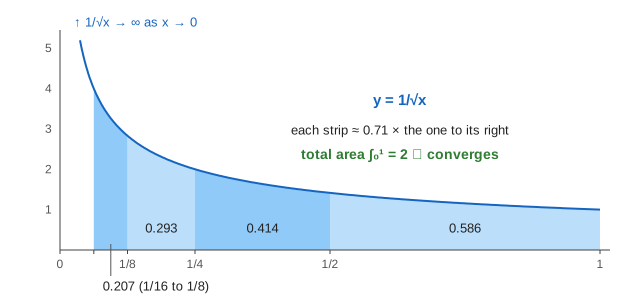
∫01 1/√x dx is improper at the other end: 1/√x → ∞ as x → 0. Take ε > 0, integrate from ε to 1 and let ε → 0: ∫ε1 1/√x dx = 2 − 2√ε → 2. For 1/x the same limit is ln(1/ε) → ∞. Here the test flips: ∫01 1/xp converges exactly when p < 1. Each push halves ε; the new strip [ε, 2ε] is half as wide, and the curve is taller there by 2p, so the strip's area is 2p−1 times the last: it shrinks only when p < 1. (Demo: infinite height, ∫₀¹ 1/√x = 2)
Gabriel's horn
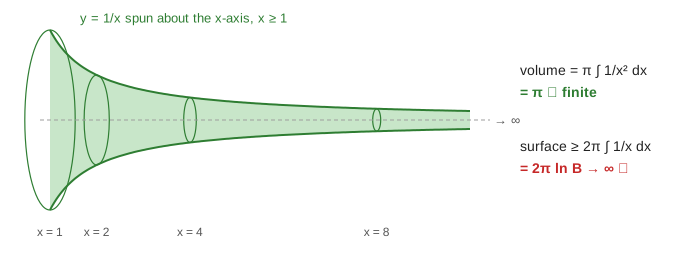
Spin y = 1/x for x ≥ 1 about the x-axis. The solid is Gabriel's horn (or Torricelli's trumpet). Its volume, by discs of radius 1/x, is π∫1B 1/x² dx = π(1 − 1/B) → π. Its surface area is 2π∫1B (1/x)√(1 + 1/x4) dx, which is at least 2π∫1B 1/x dx = 2π ln B → ∞. So the horn holds a finite amount of paint, π cubic units, yet no finite amount of paint can coat its inside wall. The paradox goes away once you notice that a coat of paint has a thickness, and the horn soon gets thinner than any coat. (Demo: Gabriel's horn, volume π, surface ∞)
Where it connects
Every value on this page is an ordinary integral F(B) − F(1) from the Fundamental Theorem of Calculus, followed by a limit, like the limits on Limits. The integrals as areas are Riemann sums; the area function that grows with B is on Accumulation; finding antiderivatives such as ln x and −1/x is on Integration Techniques; and disc volumes like the horn's are on Volume by Slicing.
The same slow growth shows up in the harmonic series 1 + 1/2 + 1/3 + …, whose blocks 1/3 + 1/4, 1/5 + … + 1/8, … each add at least 1/2; see geometric series and the harmonic series.
What the page leaves out
Integrals improper at both ends or at a point inside the interval (split them, and each piece must converge), functions that change sign and converge only conditionally, such as ∫ sin x / x, the Cauchy principal value, the limit comparison test, the exact surface area of the horn (the page shows only its lower bound 2π ln B), and numerical methods that substitute away the infinity before integrating.