The idea: a sum that never ends can still be finite
Take a square of area 1. Colour half of it, then half of what is left, then half of that, and keep going. The coloured pieces are 1/2, 1/4, 1/8, 1/16, …, and they never go outside the square. After n cuts the part still empty is exactly as big as the last piece cut, 1/2n. That gap shrinks below any size you name, so the endless sum 1/2 + 1/4 + 1/8 + … is exactly 1 (Demo: halving a square).
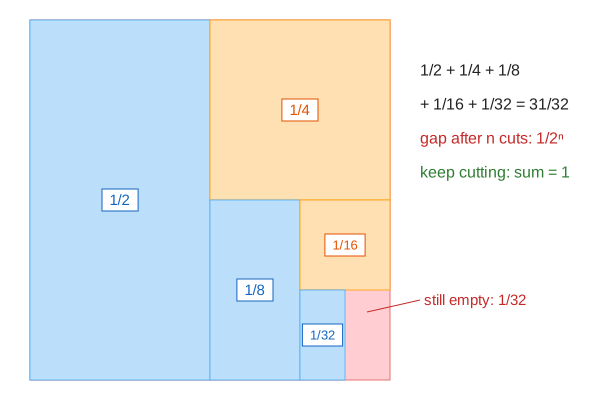
A sum like this, where each term is the one before multiplied by the same number r, is a geometric series: a + ar + ar² + ar³ + …. The number r is the ratio. In the square, a = 1/2 and r = 1/2.
Partial sums and the gap
The sum of the first n terms is the partial sum Sn. Multiply it by r and subtract: almost every term cancels.
Sn     = a + ar + ar² + … + arⁿ⁻¹
r·Sn   =     ar + ar² + … + arⁿ⁻¹ + arⁿ
Sn − r·Sn = a − arⁿ     so   Sn = a(1 − rⁿ)/(1 − r)
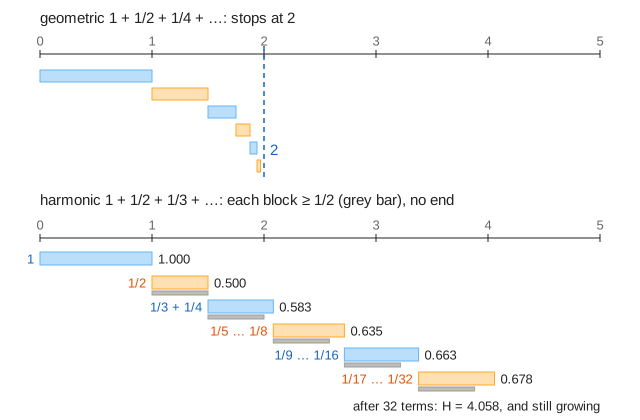
When |r| < 1, rn shrinks to 0, so Sn settles at the sum a/(1 − r). The gap that is left is |a·rn/(1 − r)|. The canvas uses a = 1 for its ladder, 1 + r + r² + …: term k is a bar from Sk−1 to Sk, and the dashed line is the sum.
| r | sum 1/(1 − r) | S8 | gap after 8 terms | terms for gap < 0.001 |
|---|---|---|---|---|
| 1/3 | 1.5 | 1.499771 | 0.000229 | 7 |
| 1/2 | 2 | 1.992188 | 0.007813 | 11 |
| 2/3 | 3 | 2.882945 | 0.117055 | 20 |
| 9/10 | 10 | 5.695328 | 4.304672 | 88 |
| −1/2 | 2/3 | 0.664063 | 0.002604 | 10 |
The closer r is to 1, the slower the gap closes: each term only shrinks it by the factor r (Demo: close to 1 is slow). With a negative r the terms change sign, so the partial sums 1, 0.5, 0.75, 0.625, … jump over the sum and back, closing in from both sides (Demo: negative r zig-zags).
Other ratios as pictures
Cut the empty part into three equal pieces, colour one blue and one orange, and repeat on the third. Blue and orange always have the same area and together fill everything but a shrinking piece, so each ends at 1/2: 1/3 + 1/9 + 1/27 + … = 1/2. After 6 rounds each colour is 364/729 ≈ 0.4993 (Demo: thirds).
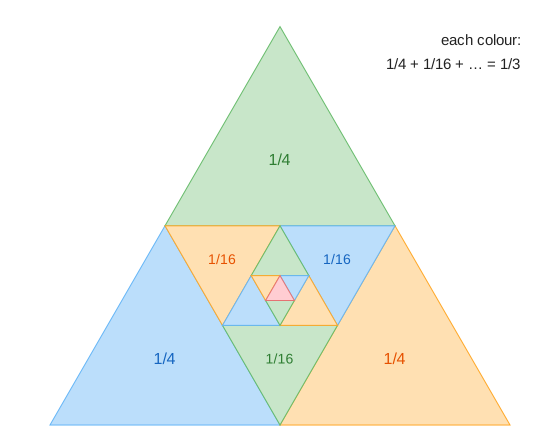
Cut the empty square into four quarters with three colours and one empty quarter, and each colour ends at 1/3: 1/4 + 1/16 + 1/64 + … = 1/3, which is 341/1024 ≈ 0.3330 after 5 rounds (Demo: quarters). Both agree with the formula: (1/3)/(1 − 1/3) = 1/2 and (1/4)/(1 − 1/4) = 1/3. The same quarter picture works with triangles:
Zeno's runner
Zeno of Elea argued that a runner can never finish: first she must reach half way, then half of what is left, and so on, an infinite number of tasks. Put numbers on it: a 100 m track at 10 m/s. The hops are 50 m, 25 m, 12.5 m, …, and the times are 5 s, 2.5 s, 1.25 s, …. After 8 hops she is at 99.609 m after 9.961 s. The times are a geometric series with sum 5/(1 − 1/2) = 10 s, so infinitely many hops fit in 10 s, exactly when 100 m / 10 m/s says she finishes (Demo: Zeno's runner).
When there is no sum
If |r| ≥ 1 the terms do not shrink, so the partial sums cannot settle and the series diverges. With r = 1 every term is 1 and Sn = n. With r = 2, Sn = 2n − 1: 1, 3, 7, 15, …, 255 after 8 terms. With r = −1 the sums flip 1, 0, 1, 0, … and never settle. The formula a/(1 − r) would give nonsense here (−1 for r = 2): it only holds for |r| < 1 (Demo: r ≥ 1 has no sum).
Terms going to 0 is not enough: the harmonic series
The harmonic series 1 + 1/2 + 1/3 + 1/4 + … has terms that shrink to 0, yet it has no sum. Group the terms in blocks that end at 1, 2, 4, 8, 16, …: the block 1/3 + 1/4 has two terms each at least 1/4, so it is at least 1/2; the block 1/5 + … + 1/8 has four terms each at least 1/8, so it is at least 1/2; and so on. There are endless blocks, each adding at least 1/2, so the partial sums Hn pass every number (Demo: the harmonic series never stops). This is Nicole Oresme's proof from about 1350.
| n | Hn | lower bound 1 + k/2 (n = 2k) | ln n + 0.5772 |
|---|---|---|---|
| 4 | 2.0833 | 2 | 1.9635 |
| 16 | 3.3807 | 3 | 3.3498 |
| 256 | 6.1243 | 5 | 6.1224 |
| 1024 | 7.5092 | 6 | 7.5087 |
It grows very slowly, like ln n + 0.5772 (the Euler–Mascheroni constant): Hn passes 10 only at n = 12,367 and 20 at n = 272,400,600. The blocks creep up to ln 2 ≈ 0.6931, the same ln 2 that each doubling of B adds to ∫1B 1/x dx on the Improper Integrals page: the sum and the integral grow together.
Where they show up
- Repeating decimals: 0.999… = 9/10 + 9/100 + … = (9/10)/(1 − 1/10) = 1, and 0.333… = 1/3.
- Doubling arrays: a growing array that doubles when full copies 1 + 2 + 4 + … + n < 2n elements in all, so one append costs O(1) on average. See Big-O Growth.
- Power series: 1/(1 − x) = 1 + x + x² + … is the Taylor series of 1/(1 − x), valid for |x| < 1. See Taylor Series.
- Decay and growth: half-lives and repeated discounts are geometric; compound interest leads to e. See Exponentials and Logarithms.
- Harmonic numbers in algorithms: average quicksort makes about 2n ln n comparisons because a sum of 1/k terms appears. See Comparison Sorts.
See also Limits & Continuity for what "the gap shrinks below any size you name" means precisely, Riemann Sums for another endless refinement that settles, and Proofs Without Words for more sums read off areas.
The Koch snowflake's area is a geometric series with ratio 4/9: each level adds less, and the total stops at 8/5 of the starting triangle while the perimeter grows forever; see Fractal Curves: Koch Snowflake, Dragon Curve, Hilbert Curve.
What the page leaves out
General convergence tests (comparison, ratio, root, integral test), the alternating harmonic series 1 − 1/2 + 1/3 − … = ln 2 and how rearranging its terms can change the sum, the p-series (1 + 1/4 + 1/9 + … = π²/6), geometric series with complex r, a proof that Hn − ln n settles at 0.5772…, and fractals such as the Koch snowflake, whose area is a geometric series while its perimeter grows without bound.