The idea: a wave inside a shrinking envelope
Pluck a guitar string or push a car down on its springs and let go. It swings back and forth, and every swing is a little smaller than the one before. That motion is
y = A · e^(−γt) · cos(ωt + φ) t ≥ 0a cosine wave multiplied by a decaying exponential. The exponential part ±A·e^(−γt) is the envelope: the wave swings between its two curves and touches them where cos(ωt + φ) = ±1.
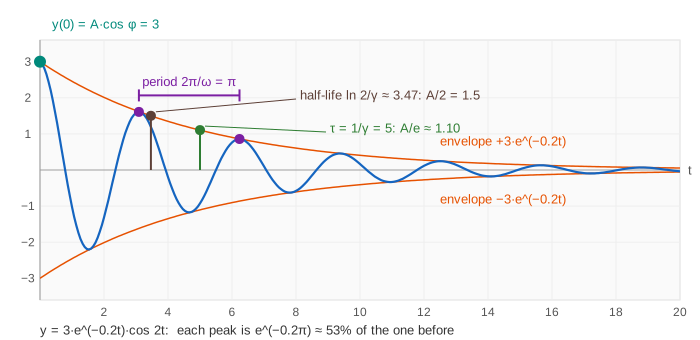
Each of the four numbers has one job:
| number | what it changes |
|---|---|
| A | the size: the envelope starts at ±A |
| γ (gamma) | how fast it dies: the envelope falls to A/e at τ = 1/γ |
| ω (omega) | how often it swings: one period lasts 2π/ω |
| φ (phi) | where it starts: y(0) = A·cos φ |
A: the starting size
A multiplies every point. Double A and the whole picture doubles in height: the envelope, every peak and y(0). Nothing moves sideways, and how fast it dies does not change. (Demo 3: A scales everything)
γ: the decay rate
γ is in the exponent, so it controls how fast the envelope shrinks. Two times tell you how fast:
- the time constant τ = 1/γ: the envelope is down to A/e ≈ 37% of A;
- the half-life ln 2/γ ≈ 0.69/γ: the envelope is down to A/2.
After ln 20/γ ≈ 3/γ the envelope is under 5% of A, which is about where you stop seeing the swings. With γ = 0.2 that is τ = 5, half-life ≈ 3.47 and 5% at t ≈ 15. γ = 0 means no damping at all: the envelope is flat and it is a plain cosine (see Cosine Graph: What a, b, c, d Do). The decay itself is the same e^(−γt) as on Exponentials and Logarithms and Exponential Functions. (Demo 1: γ from 0 to 1 in steps of 0.1: the envelope tightens and the wave dies sooner and sooner.)
γ < 0 turns the decay into growth: e^(0.1t) doubles every ln 2/0.1 ≈ 6.93, and each swing is bigger than the last. That is what an unstable system or resonance looks like: something keeps pumping energy in. (Demo 6: γ < 0, the swings grow)
ω: the period and the peak ratio
ω multiplies t inside the cosine, so one swing lasts the period 2π/ω (frequency ω/2π swings per unit of time). The envelope has no ω in it: a bigger ω packs more swings under the same envelope. (Demo 2: ω changes the swings, not the envelope)
From one peak to the next, t grows by one period, so the envelope is multiplied by the same number every time:
peak ratio = e^(−γ · 2π/ω) γ = 0.2, ω = 2: e^(−0.2π) ≈ 0.53Every peak is 53% of the one before. With the same γ, a faster wave (bigger ω) loses less per swing, because each swing takes less time.
φ: where it starts
φ slides the wave sideways inside the same envelope; the start is y(0) = A·cos φ. φ = 0 starts at the top, φ = π at the bottom, and φ = −π/2 gives cos(ωt − π/2) = sin ωt: a damped sine that starts at 0 and goes up (Sine Graph: What a, b, c, d Do). (Demo 4: φ shifts the start)
Peaks and the envelope
The wave touches the envelope where cos(ωt + φ) = ±1. Its peaks (where the slope is 0) come a little earlier, because the envelope is still falling there: at ωt + φ = 2πk − arctan(γ/ω). The shift is the same for every peak, so the peaks are still exactly one period 2π/ω apart, and the peak ratio above is exact. With small γ the difference is tiny.
Light, medium and heavy damping
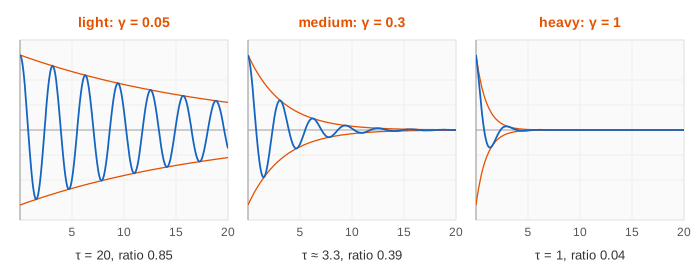
| γ (ω = 2) | τ = 1/γ | peak ratio | looks like |
|---|---|---|---|
| 0.05 | 20 | 0.85 | a guitar string: rings for a long time |
| 0.3 | 3.3 | 0.39 | a door closer that overshoots a little |
| 1 | 1 | 0.04 | a car shock absorber: one bounce and it is still |
(Demo 5: car shock absorber vs guitar string)
Where it shows up
A mass on a spring with friction, m y″ + c y′ + k y = 0, moves exactly like this when the friction is small (underdamped, γ < √(k/m)), with
γ = c / 2m ω = √(k/m − γ²)More friction c means a bigger γ and also a slightly slower swing. The same equation describes a charge sloshing in an RLC circuit (γ = R/2L, see RLC Circuits), a car's suspension and shock absorbers, a building swaying after a gust, and the fading note of a guitar or piano string. Solving such an equation step by step on a computer is on Euler's Method.
Without friction (γ = 0) a spring swings forever with ω = √(k/m) and a pendulum with ω = √(g/L): change the mass, stiffness, length or gravity, or set T, f or ω directly, on Spring Oscillator and Simple Pendulum.
Two waves that meet add up: where they are in step the swing doubles, half a wavelength apart they cancel. See Wave Interference: Two Coherent Sources.
Push a damped spring with a periodic force and this decaying wave becomes the start-up transient of a Driven Oscillator, which settles into a steady swing that peaks at resonance.
The same e^(−t/τ) decay drives a capacitor emptying through a resistor in RC Circuit; there τ = RC.
The same curve comes out of the Laplace transform: y″ + 2y′ + 5y = 0 has poles −1 ± 2i, and their real and imaginary parts are γ = 1 and ω = 2 in e^(−t)·cos 2t. See The Laplace Transform.
A wave can be trapped by an envelope that is not an exponential, too: in The Heart Curve the envelopes ∛(x²) ± √(3 − x²) draw a heart, and raising the frequency m makes the curve fill it.
Two damped waves at right angles, one for x and one for y, drive the pen of a Harmonograph, which draws a figure that spirals inward.
What the page leaves out
Critical damping and overdamping (γ ≥ √(k/m): no swings at all, just a slow return), driven oscillators and the resonance peak, energy, which decays twice as fast as the envelope (e^(−2γt)), several frequencies at once, and times before t = 0. The page also keeps the window to t ∈ [0, 20], y ∈ [−5, 5].